Brazil’s Health Ministry says it cannot tell whether gambling patients used legal or illegal betting sites
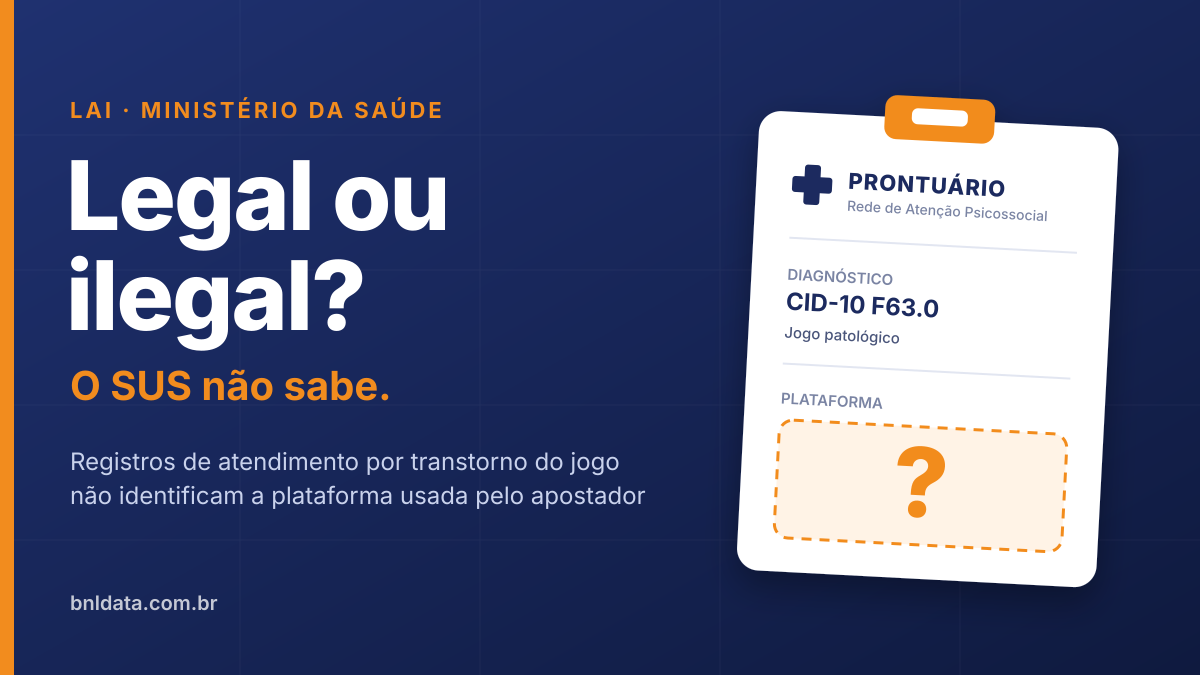
Brazil’s Ministry of Health has told BNLData that SUS records do not distinguish between licensed and unlicensed betting platforms, even as its own guidance links rising treatment numbers to the legalization and later regulation of fixed-odds betting. For PSPs and acquirers, the practical point is simple: the ministry’s public materials mix data, chronology, and attribution in ways that matter for anyone assessing the regulated market in Brazil.
- In response to an access-to-information request, the ministry said it has no way to know whether patients treated in the public health system for gambling-related problems used platforms authorized by the Secretaria de Prêmios e Apostas (SPA/MF) or illegal sites. The records use ICD-10 codes
F63.0(pathological gambling) andZ72.6(gambling and betting mania), which do not identify the channel or operator. - At the same time, the ministry said the increase in treatments “coincides with legalization in 2018 and with later regulation in 2023.” The catch is chronological: between 2018 and December 2024 there were no companies authorized to operate fixed-odds betting in Brazil. The regulated market only started on 1 January 2025, so until then online gambling activity was taking place on sites without a Brazilian licence.
- The ministry’s own 2025 Care Line, attached to the response, cites a Central Bank study saying unregistered betting companies moved R$ 20.8 billion in August 2024 alone, involving about 24 million people. That is the only concrete scale figure the ministry itself puts on the table in the documents sent with the reply.
- On projections, the answer is blunt: “O Ministério da Saúde não possui projeção de atendimentos” (“The Ministry of Health does not have a treatment forecast”). But the ministry’s 2026 Guide for the Care of People with Problems Related to Betting Games, also attached, says on page 9 that “the Ministry of Health projection indicates that the number of treatments will continue increasing.” One document denies the projection exists; another uses it as an established assumption.
- The ministry says the official count is 10,553 treatments between January 2018 and May 2025 under codes
F63.0andZ72.6. Of these, 4,316 were outpatient treatments, including Centros de Atenção Psicossocial (CAPS), and 6,237 were not fully broken out in the excerpt provided. For operators and payment providers, the key issue is not the absolute number by itself, but that the ministry is using a dataset it says cannot separate licensed from unlicensed activity.
The ministry also said it has not defined a funding source for treatment after the betting ban, and it identified the destination for only one third of the R$ 78.9 million received from the regulated sector. That leaves a familiar problem for market participants: public policy is talking about regulated gambling, but the administrative paperwork still appears to be catching up with the market it is meant to regulate.
Related news
All news →


Weekly high-risk digest
Regulation, sanctions and payment news across your verticals — once a week, free.
Please check your inbox and click the link to confirm your subscription.
Please enter a valid email address!