Brazil’s retail sales fell 4% in October 2026 after the first full month without regulated betting
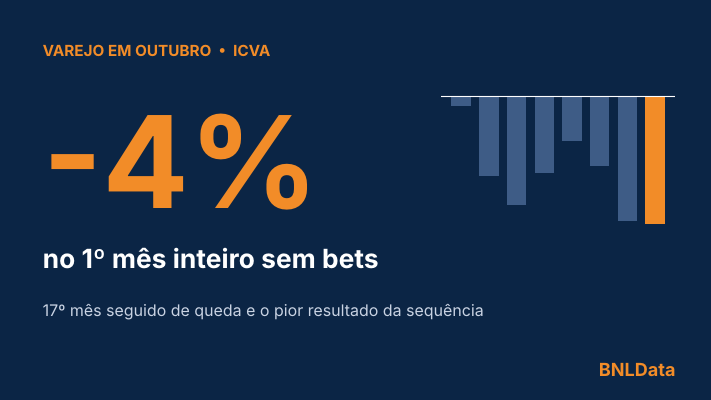
The October ICVA (Cielo Extended Retail Index), published by Folha de S.Paulo, shows that the “money redirected from bets into commerce” thesis did not show up in the numbers. For high-risk payment providers, the point is simple: when a regulatory change is supposed to reallocate consumer spend, you need to wait for the data, not the speeches.
- Brazilian retail fell 4% in October 2026 versus October 2025, after inflation, according to the ICVA. That was the worst October since 2023. In nominal terms, sales rose only 1.3%, which means consumers paid more and took less home.
- October mattered because it was the first full month without bets. MP 1.394 was published on 25 September, and the deadline for bettors to withdraw balances ended at 23:59 on 5 October. September, then, was not a clean month for measurement. October was the first real test, and the result did not support the claim that retail would get a lift from the end of regulated betting.
- The decline had already been going on, but it got worse. With October, Brazilian retail posted 17 straight months of real contraction in the ICVA, and the -4% result was the weakest in that entire run, even below September’s -3.9%. In September, Cielo had already reported a 9% drop in services and a 7.3% drop in durable goods.
- If money really moved from betting into commerce, the first signal should have appeared in discretionary spending. Instead, durable goods fell 8.9% and services fell 8.5%. Digital commerce, where the competition with betting platforms should be most visible, still fell 0.5% in nominal terms. By region, the sharpest drops were in Centro-Oeste (-5.4%) and Sudeste (-5.2%).
- The supermarket narrative also does not prove much on its own. ABRAS highlighted a 6.5% weekly gain in supermarkets between 5 and 11 October and called it “atypical,” but that window also included the end of the withdrawal period and the extended Dia das Crianças holiday. In July, when bets were still operating legally, supermarkets and hypermarkets had already been the strongest positive category among non-durable goods in the ICVA.
For PSPs, acquirers, and merchants watching Brazil, the lesson is not about consumer psychology. It is about timing: if a policy change is meant to move volume from one bucket to another, the evidence has to show up in discretionary categories and in the first clean reporting month. Here, it did not.
Related news
All news →
FIA Traces Nearly Rs690 Million in Pakistan Online Gambling Probe and Seeks Freeze on Faisalabad-Linked Account

Bally’s Q3 revenue rises 21% to $807.6 million as Intralot lifts group results and Star faces A$260 million AML fine

LNbits pushes emergency patch after reported Bitcoin wallet thefts
Weekly high-risk digest
Regulation, sanctions and payment news across your verticals — once a week, free.
Please check your inbox and click the link to confirm your subscription.
Please enter a valid email address!