Home/news/Smarter Tokens Could Make AI Purchases Auditable, Ixopay’s Jill Willard Says
news
Smarter Tokens Could Make AI Purchases Auditable, Ixopay’s Jill Willard Says
Payments High Risk
15 Jul 2026 · 2 min read
As AI agents start researching, negotiating and buying on behalf of users, payments infrastructure has to answer a question it was not built for: not just whether a credential is valid, but whether the agent had the right to act at all. For PSPs, that turns tokenization, orchestration, fraud controls and compliance into the machinery of proving intent, not just moving money.
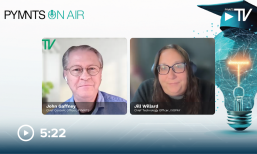
Ixopay Chief Technology Officer Jill Willard told PYMNTS during the 2026 PYMNTS original series Summer School that the first issue in agentic commerce is intent: “Is the agent acting correctly on behalf of the user?” In her framing, payments systems have to evaluate not only whether the agent is valid, but whether the intent granted to it is valid and whether the agent keeps behaving as expected.
Willard said there is currently “nothing in the payment stack today that thinks about intent.” That matters because AI agents are moving beyond simple checkout actions into researching products, comparing offers, negotiating prices and completing purchases without direct human intervention. In other words, the payment layer is being asked to police delegated authority, not just authorization.
She described agentic commerce as a coordination problem. Identity is no longer a binary check; it becomes continuous, with the payment stack acting as an operating layer that synchronizes identities, credentials, network rules, fraud signals and AI agents across them. Her neighbor analogy was blunt enough to make the point: knowing someone exists is one thing, finding them unexpectedly in your living room is another.
Willard also pushed back on the idea that orchestration means routing. “Routing is one component of orchestration,” she said, adding that orchestration also includes tokenization, network tokens, digital wallets, 3DS (3-D Secure), authentication fallbacks, fraud controls, failover strategies and operational visibility. For merchants using multiple PSPs, multiple markets and multiple payment methods, routing becomes only one decision in a much larger control stack.
The article’s second section says tokenization is taking on a broader role as autonomous software starts making purchasing decisions. Payments are no longer simply the last step in commerce; they become one of the systems governing it. The practical implication for high-risk PSPs is straightforward: if AI agents are going to buy, the system needs auditability around what was delegated, what was executed and whether the agent stayed inside that mandate.