China’s gambling ban still sends about 1 trillion yuan a year offshore through VPNs, crypto, and foreign sites
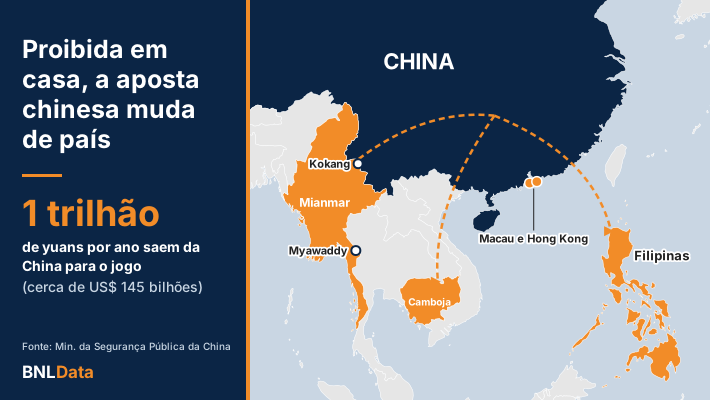
China has one of the world’s strictest gambling bans, but the money keeps moving anyway: at least 1 trillion yuan, or about US$145 billion, leaves the country each year for underground gambling and offshore operators. For high-risk payment providers, the interesting part is not the ban itself; it’s the payment stack built around bypassing it.
- Gambling has been illegal in mainland China since 1949, with only two formal exceptions: state lotteries and the casinos in Macau and Hong Kong, which operate under separate regimes. In practice, Chinese players still buy official lottery tickets, travel to legal gambling hubs abroad or in the special administrative regions, and use online gambling companies based outside the country.
- The scale of the outflow was acknowledged by the government itself. Liao Jinrong, director of International Cooperation at the Ministry of Public Security, said at least 1 trillion yuan leaves China every year for gambling activities, increasing the country’s economic and financial risks. He also said criminal groups use digital currencies to raise and transfer funds, which makes it harder to trace the source of the money and complicates investigations. Jia Kang, a former senior official at the Chinese Academy of Fiscal Sciences under the Ministry of Finance, said the figure is equivalent to about 1% of China’s GDP.
- The legal channel is huge, but it is still only the legal channel. In 2025, China sold almost 628 billion yuan in lottery tickets, or about US$90 billion, up 0.7% from the previous year, according to the Ministry of Finance. China Sports Lottery accounted for 419.39 billion yuan, roughly two-thirds of the total, while Welfare Lottery brought in 208.58 billion. Official data says the country has more than 300 million registered bettors.
- Demand shows up most clearly around major sports events. During the 2026 World Cup, sales of football lottery products reached 6.87 billion yuan between 8 and 14 June, up 97% from the previous week. The state offering, however, does not satisfy all demand: odds are less attractive, the product range is limited, and there is no legal online casino. That gap has pushed users toward foreign sites and online platforms aimed at Chinese citizens.
- The workaround is technical before it is financial. Foreign sites are blocked by the Great Firewall, so the usual entry point is a virtual private network (VPN). With VPNs, clandestine banking networks, and payment platforms, mainland players access gambling sites and send money to them. Beijing has tried to close that door for years: the Ministry of Industry and Information Technology now requires government approval for all VPN services, and state-owned telecom operators were ordered to suppress unauthorized connections.
For PSPs, banks, and acquiring partners, this is the uncomfortable part of the China gambling story: the demand is massive, the legal channel is tightly controlled, and the bypass infrastructure depends on VPNs, digital currencies, and informal payment rails that are designed to be hard to see. That is exactly the kind of flow compliance teams end up staring at after the fact.
Related news
All news →
Argentina’s Senate races to amend online gambling bill before it loses parliamentary status

Bets brought R$ 12.075 billion to Brazil’s federal tax office through October 2026, but October was the first clear drop after the ban

Brazil court freezes R$ 3.8 million in assets linked to MC Ryan amid PF money laundering probe
Weekly high-risk digest
Regulation, sanctions and payment news across your verticals — once a week, free.
Please check your inbox and click the link to confirm your subscription.
Please enter a valid email address!