377 INSS sick leaves for gambling disorder versus more than 4 million temporary disability benefits in Brazil
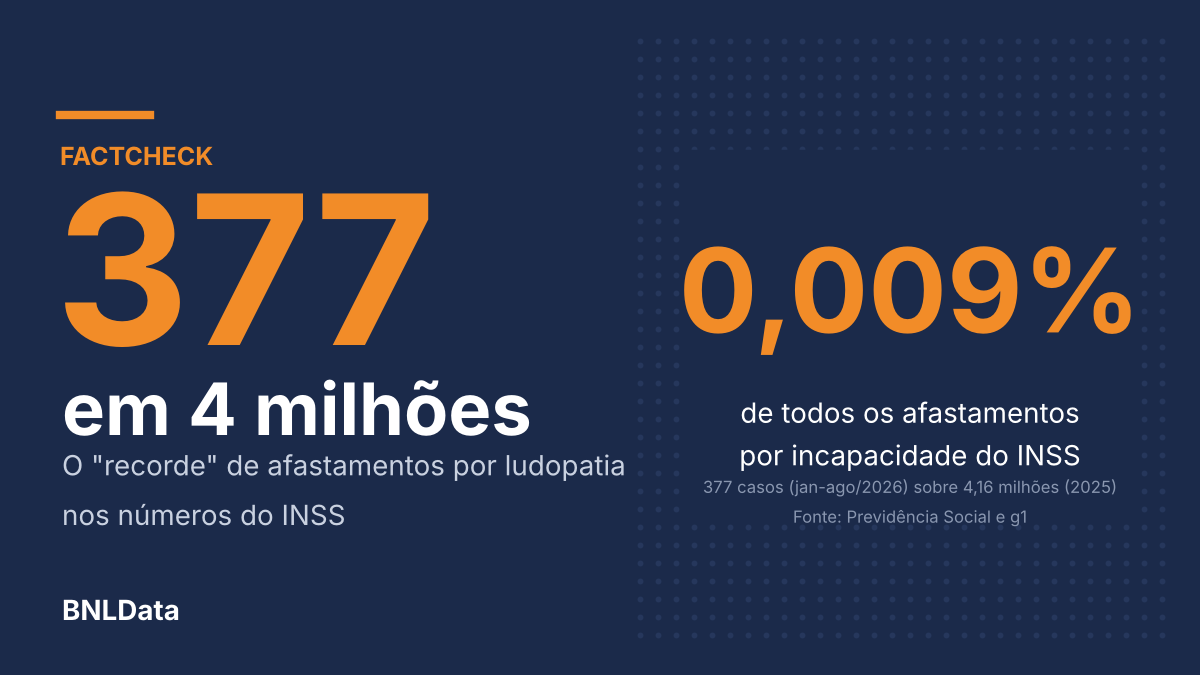
g1 treated the 377 INSS cases linked to gambling disorder as a record, but the scale matters: in 2025, Brazil’s INSS granted more than 4 million temporary disability benefits, and gambling disorder accounted for 312 of them. For PSPs, acquirers, and banks touching Brazil’s regulated betting market, the more relevant question is not whether the number exists, but how it compares with the taxes and social-security flows the sector generates.
- g1 published a report on 31 October about INSS benefits granted under CID F63.0, the code for pathological gambling. The report counted 377 sick leaves between January and August 2026, versus 312 for all of 2025. The numbers are real; the argument in the source text is that the scale is missing from the headline.
- In 2025, INSS granted more than 4 million temporary disability benefits, the former auxílio-doença. Of those, 546,254 were for mental health disorders. The 312 gambling-disorder cases were 0.06% of mental-health-related absences and less than 0.01% of the total. Rounded up, the comparison is 377 cases out of 4 million.
- Among the ten diagnoses that most often kept workers off work for mental health reasons in 2025, alcohol ranked eighth with 12,758 approvals. Gambling disorder did not appear in the ranking. Alcohol, cocaine, and multiple drugs together accounted for about 45,000 absences in 2025, or 146 times the gambling-disorder total. Even if 2026 is projected out for the full year, at about 566 pathological gambling cases, alcohol alone remains 22 times larger.
- The report argues that gambling disorder may be underreported because many bettors enter INSS using depression or anxiety codes. The source text notes that the same problem exists for alcohol and drug dependence, which also arrive at medical review under those diagnoses. In other words, underreporting does not change the ratio.
- The payment side is where the numbers get more useful. Regulated bets in Brazil did not only pay taxes: by law, part of the revenue went directly to Social Security and the Ministry of Health. In 2025, those legal allocations totaled R$ 4.5 billion. In the first half of 2026, social allocations totaled R$ 2.49 billion, including R$ 24.19 million for Health.
On top of that, betting operators pay PIS and Cofins, which also fund Social Security. In 2025, the Receita Federal collected R$ 9.95 billion in taxes from the sector; from January to September 2026, it collected R$ 11.12 billion.
- Looking at the regulated market as a whole, between January 2025 and August 2026, authorized bets generated R$ 67 billion in GGR, according to SPA/MF data obtained by BNLData via the Brazilian Access to Information Law. Under the percentages set by Law 14.790/2023, the Bets Law, that implies about R$ 804.5 million for Social Security and R$ 80.4 million for the Ministry of Health.
- The source text says g1 estimated that gambling-disorder sick leave cost Social Security R$ 4.8 million between June 2023 and August 2026. On that basis, the 2025 transfer from bets to Social Security alone covered that amount 95 times. Over the full regulated period, the R$ 804.5 million allocated to Social Security equals 168 times that cost.
Related news
All news →

Weekly high-risk digest
Regulation, sanctions and payment news across your verticals — once a week, free.
Please check your inbox and click the link to confirm your subscription.
Please enter a valid email address!