The global betting map is shifting toward regulated scale, with Brazil, North America and Europe pulling capital
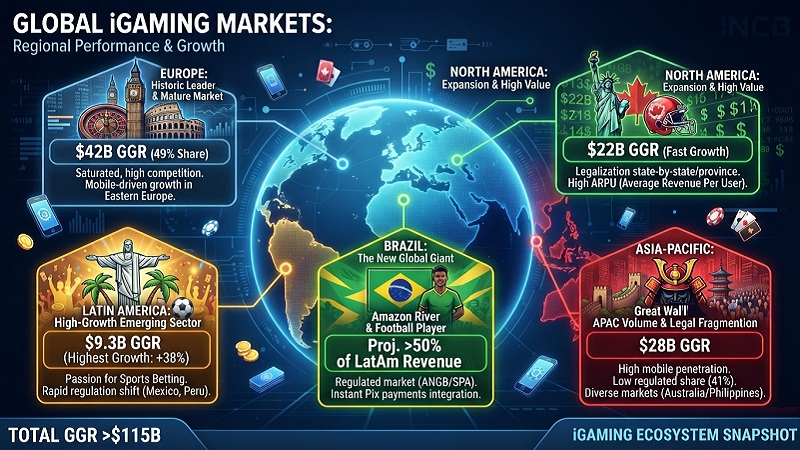
Operators are putting more weight on in-play betting, personalization, AI-driven pricing and responsible gaming tools because those features support retention and make markets easier to defend. For PSPs and acquiring teams, the real story is where regulated volume is concentrating: North America, Europe and Latin America, with Brazil now doing a lot of the heavy lifting.
- North America remains the scale market, especially the United States and Canada. The U.S. has seen the number of legalized states continue to expand, and the market is mature enough that operators are now focusing on product depth, retention and profitability rather than pure acquisition. Canada is also drawing attention, with market forecasts pointing to strong growth and a high CAGR through 2030.
- The payment angle matters as much as the betting angle. The article’s central point is that capital is flowing toward operators that can scale efficiently in regulated environments, especially where payments, compliance and customer experience can be standardized across multiple provinces or states. That is the sort of setup PSPs like: fewer one-off exceptions, more repeatable onboarding and processing logic.
- Europe is still the benchmark, but it is a more selective one. The continent remains the most mature betting region, with an established customer base, deep sports culture and advanced online betting infrastructure. But operators are increasingly concentrating on markets with legal clarity, sustainable tax structures and manageable advertising rules. IBIA has argued that strong integrity provisions, balanced advertising parameters and practical player protection are the ingredients that make betting markets work, which helps explain why capital still favors well-regulated European jurisdictions.
- Latin America is where the growth narrative has become most concrete, and Brazil sits at the center of it. Brazil’s regulated market is still in its early consolidation phase, but official data already points to more than 25 million unique bettors, around 100 million active accounts and estimated GGR of R$36.9 billion (USD 7.7 billion). For payment teams, that is not an abstract TAM slide; it is a large market with real transaction volume and local payment behavior that has to be handled properly.
- Brazil’s Regulatory Agenda for 2026-2027 gives operators and providers a clearer map. It sets out priorities including authorization criteria, payments, anti-illegal betting measures, affiliate advertising and responsible gaming. In practice, that kind of agenda is useful because it turns a fast-moving market into something a PSP, acquirer or sponsor bank can actually underwrite against.
Across the region, the smart money is moving toward markets where regulation is becoming more predictable and where local payment habits, especially instant transfers, can support long-term user adoption. For high-risk payment providers, that usually means the same thing: the money follows jurisdictions where compliance can be standardized and volume can be scaled without reinventing the stack every quarter.
Related news
All news →


Weekly high-risk digest
Regulation, sanctions and payment news across your verticals — once a week, free.
Please check your inbox and click the link to confirm your subscription.
Please enter a valid email address!