Home
/
news
/
Anbima study on online betting in Brazil says most bettors show no risk signals and points to financial education, not a ban
news
Anbima study on online betting in Brazil says most bettors show no risk signals and points to financial education, not a ban
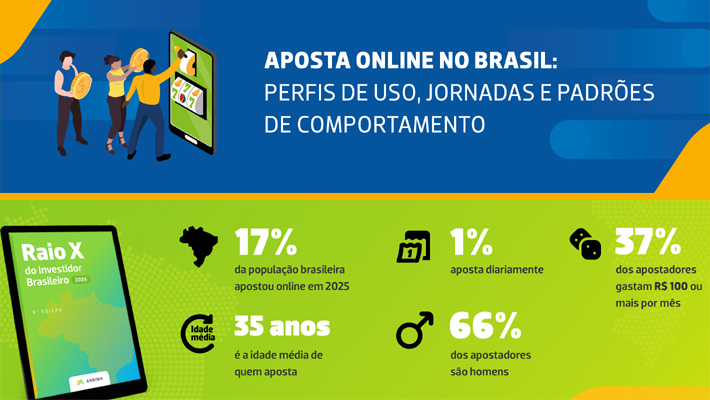
A new Anbima study, produced with Kyvo, cuts against the usual “generalized addiction” narrative around bets in Brazil. Based on in-depth interviews with 60 bettors and former bettors across the country’s five regions, it argues that most users do not show warning signs and that financial education, not new restrictions or a ban, is the appropriate response.
- Anbima released Aposta Online no Brasil: perfis de uso, jornadas e padrões de comportamento this week, with Kyvo as the research partner. The report is based on qualitative interviews with 60 bettors and former bettors in Brazil’s five regions, so this is not a mass survey, but it is still useful reading for regulated operators and PSPs trying to understand how Brazilian users actually describe their behavior.
- The study was triggered after an increasing number of Brazilians said they “invest” in bets during Anbima interviews about investment habits. It divides users into four profiles: “Adepto da Fortuna,” “Matador de Leões,” “Expert da Realidade,” and “Caçador de Emoções.”
- The first two profiles are predominantly women from classes C, D, and E. “Adepto da Fortuna” refers to women who expect to get rich quickly through betting platforms. “Matador de Leões” covers women in greater financial difficulty who use bets to pay essential bills such as water, electricity, and rent. For payment flows, that is the part of the market where affordability and repeat funding pressure matter more than the usual entertainment narrative.
- “Expert da Realidade” and “Caçador de Emoções” are mainly young men from classes A and B. In the first group, users study games, build strategies, and see bets as an alternative to the financial market. In the second, users were drawn in by friends or close contacts and treat the activity as a hobby to fight boredom. In other words: not one bettor archetype, but several very different use cases, which is exactly the sort of thing PSPs and acquirers have to price and monitor differently.
- Using data from the 9th edition of Raio X do Investidor Brasileiro (2026), the report says betting is still mostly occasional: 7% of Brazilians bet rarely and only 1% do so daily. Among bettors, 11% are classified as having a high propensity for addiction, which means nearly 9 in 10 do not fall into that risk criterion. The report’s own wording is careful here: “although most bettors do not show alarming signs,” there is still a relevant vulnerable group, concentrated in specific segments such as men, young people, and class C.
- One of the clearest takeaways for the regulated side is that entertainment is growing as the main motivation. The study cites the same Raio X and says 32% of Brazilians bet for recreation, which gives operators and payment providers a more grounded framing than the blanket “everyone is chasing losses” story that tends to travel faster than the data.
Related news
All news →/https://i.s3.glbimg.com/v1/AUTH_59edd422c0c84a879bd37670ae4f538a/internal_photos/bs/2026/6/Y/s062vdSYmGSK6yycXYvg/flavio-bolsonaro-live-23-set.jpg)
news
Flávio Bolsonaro calls Lula’s Brazil betting crackdown “electoral fraud” as government seeks to ban online bets

news
Brazil’s MP 1.394/2026 ends licensed fixed-odds betting in 30 days, keeps the fees, and leaves operators on the hook

news
ABRAJOGO says Brazil’s ban on fixed-odds betting breaks the regulatory framework and weakens legal certainty
Weekly high-risk digest
Regulation, sanctions and payment news across your verticals — once a week, free.
Please check your inbox and click the link to confirm your subscription.
Please enter a valid email address!