Brazil’s betting licensing reset becomes a legal-risk case study for embassies and investors
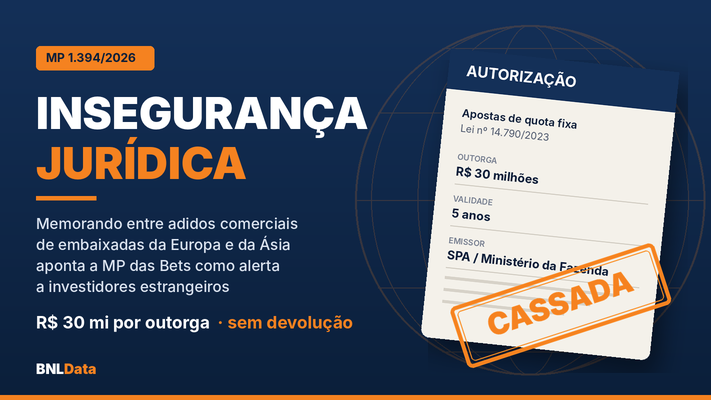
A memorandum circulating among commercial attachés from major European and Asian embassies points to Brazil’s betting crackdown as a clean example of legal instability: operators paid R$ 30 million each for five-year authorizations, lost them in under two years, and are now facing a federal lawsuit. For high-risk PSPs, the point is not the politics; it is the mechanics of state-backed licensing, fee collection, and regulatory reversal.
- The case centers on MP 1.394/2026, which the memo says turned Brazil’s betting market into a cautionary tale for investment risk. According to the text, companies licensed by the Ministry of Finance will not receive a refund of the R$ 30 million authorization fee they paid for a five-year term.
- Under Law 14.790/2023, betting operators did not receive a concession; they received a paid authorization valid for five years, with a fixed outorga of R$ 30 million. The problem, in practical terms, is that the state sold the license upfront and then ended the regime before the first authorization reached even half of its term.
- The Ministry of Finance says 85 companies were authorized by the Secretaria de Prêmios e Apostas (SPA) to operate fixed-odds betting. At R$ 30 million per authorization, that implies at least R$ 2.55 billion in outorgas paid to the federal government, money that will not be returned.
- The timeline is the part compliance teams will notice immediately: the regulated national market began on 1º de janeiro de 2025, the betting ban took effect on 25 de setembro de 2026 with the publication of the MP, users had until 5 de outubro to withdraw balances, and the authorizations were extinguished on 25 de outubro, one month after publication and on the same day as the second round of elections.
- After keeping the authorization fees, the federal government also went to court. The AGU filed a lawsuit against 17 online betting operators, seeking at least R$ 1 billion for collective moral damages and reimbursement of SUS expenses tied to treatment related to gambling addiction.
The official tax numbers show why this matters beyond the betting sector itself: according to Receita Federal data, betting companies paid R$ 9.95 billion in federal taxes in 2025 and R$ 8.747 billion between January and July 2026, up 76%. For PSPs, the issue is straightforward: when a jurisdiction can revoke paid-for market access this fast, licensing risk is not a footnote; it is the product.
Related news
All news →


Weekly high-risk digest
Regulation, sanctions and payment news across your verticals — once a week, free.
Please check your inbox and click the link to confirm your subscription.
Please enter a valid email address!