In Brazil’s regulated betting market, the state takes R$ 2.58 for every R$ 1 of operator profit, according to a CEO’s 2025 model
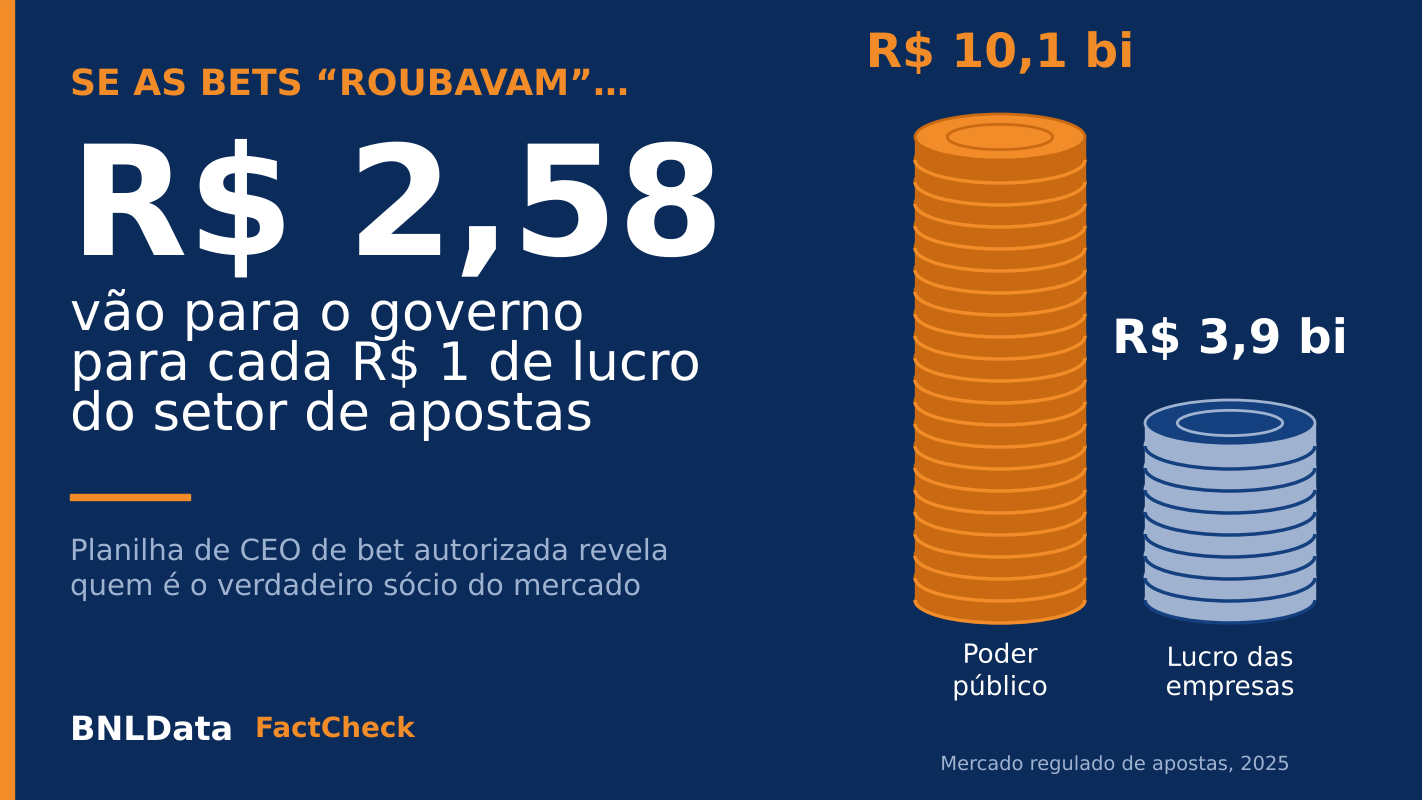
A spreadsheet sent to BNLData by the CEO of an authorized betting operator says that, out of every R$ 100 of GGR in 2025, R$ 27.40 went to the public sector and R$ 10.60 became net profit. For PSPs, acquirers, and partners watching Brazil’s regulated betting stack, the takeaway is simple: the government is the biggest beneficiary of the flow, even before you add every charge on top.
- After the Brazilian government’s Instagram post arguing that “bets always won” and talking about “the money that bets stole from you,” BNLData reported that the government collected R$ 9.95 billion from the regulated market in 2025, equal to 27% of GGR.
- Following that publication, the CEO of an authorized betting platform supervised by the Secretaria de Prêmios e Apostas (SPA-MF) contacted the newsroom, asked not to be identified, and sent an estimated 2025 income statement for the Brazilian market built from the reality of his own operation.
- In that model, the public sector takes the largest slice of each R$ 100 of GGR: R$ 27.40 goes to the government, ahead of marketing at R$ 25 and rewards returned to players at R$ 20. Net profit comes to R$ 10.60.
- On the full-market level, the spreadsheet puts government take at R$ 10.1 billion in 2025, while total net profit for the regulated market is R$ 3.9 billion. That means the state receives R$ 2.58 for every R$ 1 earned by operators.
- The biggest line item is the legal destination charge, equal to 12% of GGR, which totals R$ 4.44 billion and is allocated to sport, tourism, public safety, education, health, and social security. Then come PIS/Cofins at R$ 3.01 billion, IRPJ and CSLL at R$ 2.03 billion, and ISS at R$ 0.65 billion.
- The starting point is the official 2025 GGR of R$ 37 billion, defined as total stakes minus prizes paid out. The executive’s assumptions were used for cost percentages, while taxes were calculated on the legal base. PIS/Cofins at 9.25% and ISS at 2% are applied to the 88% of GGR left after legal destinations, which is how the model gets to 8.14% and 1.76%.
The model does not include at least two government payments. One is the outorga, the R$ 30 million authorization fee paid for a five-year license, which the executive did not amortize. The other is the monthly inspection fee charged by the SPA-MF by revenue band. Add both, and the public sector’s share goes up again, while operator profit goes down.
There is also a practical footnote for the market: since 2025, Law 14.790 has banned welcome bonuses and any pre-bet advantage. That matters because bonus costs used to be one of the cleaner ways operators bought volume; without them, the economics shown in this spreadsheet become even more relevant for anyone underwriting Brazilian betting flows.
Related news
All news →

Weekly high-risk digest
Regulation, sanctions and payment news across your verticals — once a week, free.
Please check your inbox and click the link to confirm your subscription.
Please enter a valid email address!