Durigan’s “plebiscite” on online betting did not deliver votes to Lula in Brazil’s first round
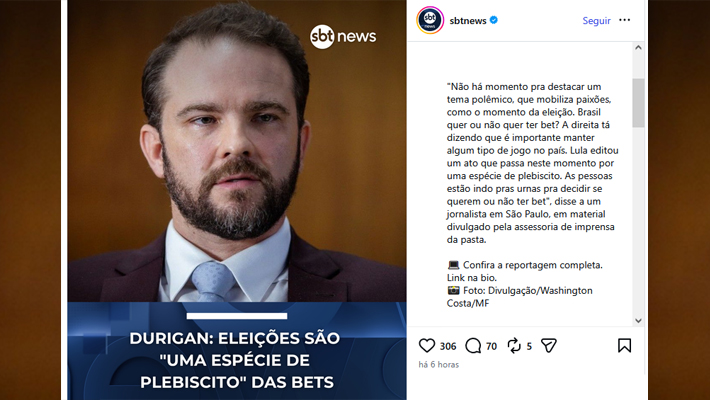
Brazil’s Finance Ministry framed the ban on online betting as a kind of referendum at the ballot box. The first-round result did not reward that bet: President Luiz Inácio Lula da Silva finished 2,224,965 votes behind Flávio Bolsonaro, almost exactly where he had been before MP 1.394.
- Finance Minister Dario Durigan made the argument in São Paulo on Sunday (4), saying voters would decide whether Brazil should “have bets” at all. His comments were distributed by the ministry’s press office and explicitly tied the election to MP 1.394, the measure that prohibited online betting in the country.
- On paper, the government had polling on its side. According to Quaest, 62% of respondents supported restricting online betting, and an Atlas/Bloomberg survey put support for the ban at 75%. Lula’s campaign also leaned into the issue in the final stretch, with a Rio event projecting the line: “Flávio is bet. Lula is the way.”
- In practice, the votes barely moved. Flávio Bolsonaro (PL) finished the first round with 56,104,503 votes, or 47.03% of valid votes, against Lula’s 53,879,538 votes, or 45.16%. The gap was 2,224,965 votes, or 1.87 percentage points. The two advanced to the second round on 25 October.
- The timeline matters here. MP 1.394 was announced on 25 September, nine days before voting. Before the measure, Datafolha had Lula at 43% of valid votes in a poll conducted from 8 to 10 September. He ended the first round at 45.16%, a gain of a little more than two points, which sat within the poll’s margin of error.
- The first post-announcement poll did not show a meaningful jump for Lula either. In Quaest’s 28 September survey, Lula moved from 37% to 39%, Flávio from 33% to 34%, and both were tied at 42% in a second-round simulation. Government approval rose from 44% to 46%, while disapproval stood at 49%. All of those changes were within the margin of error.
The more useful read for high-risk operators is simpler: even a measure backed by strong public support did not automatically translate into a political win for the government. Flávio Bolsonaro, meanwhile, went from roughly 37% in September polling to 47.03% at the ballot box, consolidating opposition votes that had been spread across other candidates.
Related news
All news →
Winning Poker Network Makes ScreenShield the Default on Americas Cardroom From November 4

Bitget adds Kazakhstan, Russia, and Belarus to its restricted countries list

Brazil’s sudden betting ban puts more than R$ 9 billion in federal tax revenue, R$ 30 million licence fees, and billions in sponsorship contracts back in play
Weekly high-risk digest
Regulation, sanctions and payment news across your verticals — once a week, free.
Please check your inbox and click the link to confirm your subscription.
Please enter a valid email address!