Home/news/Deepfakes and identity fraud: what iGaming operators need to verify beyond the selfie
news
Deepfakes and identity fraud: what iGaming operators need to verify beyond the selfie
Payments High Risk
27 Nov 2026 · 2 min read
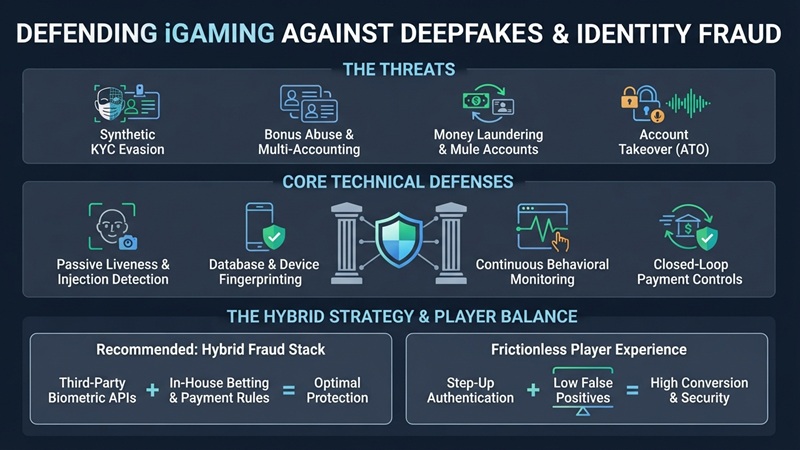
AI-driven identity fraud is getting harder to catch, and for iGaming operators the problem is not just fake documents or spoofed selfies. It reaches into onboarding, account access, payment requests, compliance, and player protection, which is why a single biometric check is not a serious control on its own.
The core risk is broader than image manipulation. Deepfake videos, manipulated identity documents, synthetic identities, and biometric spoofing can all be used to bypass verification procedures, create fraudulent accounts, or gain unauthorized access to existing ones. For operators, that means the question is not only whether an image or video looks fake, but whether the person registering, logging in, or requesting a transaction is actually the person they claim to be.
The article points to a layered approach rather than a single tool. That means combining reliable identity verification, continuous monitoring, secure authentication, and clear procedures for responding to suspicious activity. In practice, this starts at registration: traditional Know Your Customer (KYC) checks based mainly on document submission and static facial comparison may not be enough when criminals can manipulate images or generate convincing identity materials.
At onboarding, operators should combine document authenticity checks, facial comparison, and liveness detection. The point of liveness detection is to establish that the biometric sample comes from a live person physically present during verification, not from a photograph, prerecorded video, mask, or other artificial representation. Operators should also test whether the system has been independently evaluated against presentation attacks and whether it is fit for remote onboarding.
The National Institute of Standards and Technology (NIST), in its 2025 Digital Identity Guidelines, addresses identity proofing, authentication, and presentation attack detection. The guidance recommends presentation attack detection for remote biometric collection and references ISO/IEC 30107-3:2023 as a testing standard. For operators evaluating vendors, that is the useful bit: use technical benchmarks, not marketing copy, when assessing identity tools.
The article also warns against treating one strong control as a complete answer. Even sophisticated biometric systems have limits, and a system that performs well against one type of manipulation may not be reliable against another. For iGaming compliance and fraud teams, the operational takeaway is simple: build identity controls as a stack, not a checkbox.