Brazil: ANJL says banning licensed betting would push more users into the illegal market

A Brazilian industry meeting focused on a familiar problem with an unfriendly twist: if licensed betting is banned, users do not disappear, they move. Bernardo Freire of ANJL said that would strengthen clandestine operators in a market where, by his estimate, 40% of the population already accesses the illegal segment.
- Freire, ANJL’s legal adviser, called a possible ban on legalized betting companies in Brazil “complicity with crime,” arguing that licensed operators already work under rules covering LGPD (Lei Geral de Proteção de Dados), anti-money laundering, and protection of minors.
- His core point was simple: removing regulated operators would not remove demand. In his view, it would push users toward unlicensed platforms that are not subject to the same compliance duties on AML, data privacy, and consumer protection.
- Freire said the ban could drive the remaining 60% of users into the illegal market, after 40% of the population has already accessed it. For PSPs and payment teams, that is the practical part of the argument: fewer regulated endpoints usually means more volume flowing into harder-to-control channels.
- Freire is also a partner at Betlaw, a firm that advises and litigates for betting houses, payment entities, and other service providers tied to the sector.
- ANJL president Plínio Lemos used the same forum to push back on what he described as a campaign of discrediting against the industry in Brazil, saying public debate should be based on verifiable information and questioning media claims about betting and household debt.
For high-risk payment providers, the takeaway is not subtle: Brazil’s regulated betting framework is being defended not just as a licensing issue, but as a compliance perimeter. Once that perimeter shrinks, the payment flow does not vanish — it gets harder to screen, harder to monitor, and easier to route through operators with none of the usual obligations.
Related news
All news →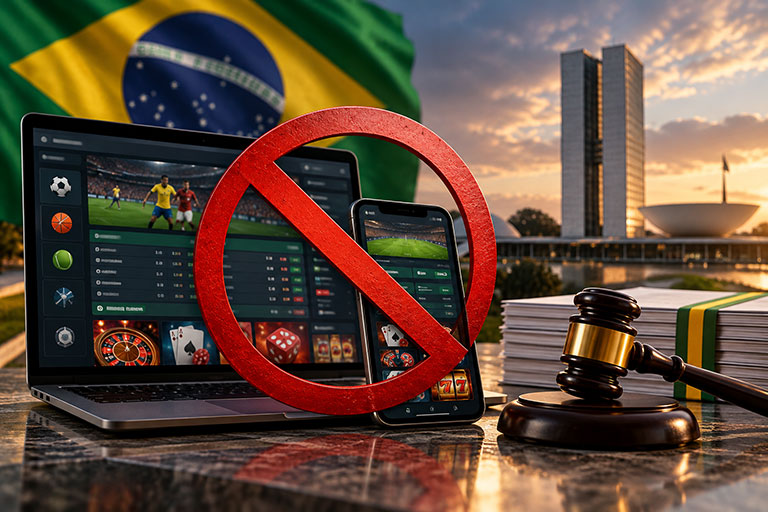
Brazil bans online fixed-odds betting nationwide as Lula signs Provisional Measure No. 1,394
/https://i.s3.glbimg.com/v1/AUTH_59edd422c0c84a879bd37670ae4f538a/internal_photos/bs/2026/Y/0/v2wti0SXaSBGcDyBzkuQ/montagem-two-rows-1280x720px.jpg)
Before the ban, what Brazil’s presidential candidates were saying about online betting
Brazil: Why a Quick Reversal of the Gambling Crackdown Should Not Be Expected, According to Ilya Machavariani
Weekly high-risk digest
Regulation, sanctions and payment news across your verticals — once a week, free.
Please check your inbox and click the link to confirm your subscription.
Please enter a valid email address!