The numbers do not add up: GCI’s figures in Lauro Jardim’s column try to erase what regulation has already achieved
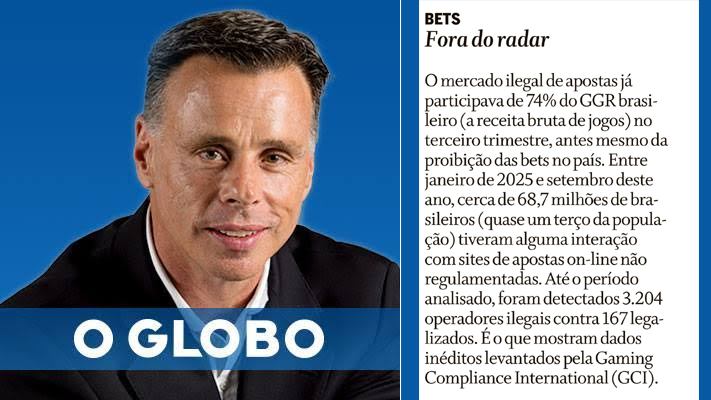
Data cited in O Globo claims Brazil’s illegal betting market still captured 74% of GGR in the third quarter, but the benchmark estimates from H2 Gambling Capital and LCA Consultores point in the opposite direction: regulation brought most of the volume into the licensed market in its first year. For PSPs, the difference is not academic — it changes the view on canalisation, enforcement, and where payment risk actually sits.
- A column by Lauro Jardim, published in O Globo on Sunday (15) under the title “Fora do radar,” cited Gaming Compliance International (GCI) data saying the illegal betting market accounted for 74% of Brazil’s GGR in the third quarter, “even before the prohibition of bets.” It also said 68.7 million Brazilians “had some interaction” with unregulated sites between January 2025 and September 2026, and that there were 3,204 illegal operators versus 167 licensed ones.
- The problem is that the benchmark estimates point the other way. H2 Gambling Capital, which measured the Brazilian market using three sources — a survey of bettors, Pix transactions from the Central Bank, and online traffic — estimated that about R$ 15 billion in annual GGR was circulating outside the regulated market, or about 30% of the total. After the MP review, H2 put the offshore share at 30% before the ban, around R$ 17 billion, and said illegal volume could rise to R$ 42 billion.
- LCA Consultores, together with Instituto Locomotiva and commissioned by IBJR, also points to a shrinking illegal share: from 41% to 51% in 2025 down to 38% to 44% in the first half of 2026. Put together, the reference estimates suggest the regulated market captured most of the bets in less than two years of operation — not a trivial result for a vertical that had been prohibited for 85 years.
- The arithmetic behind the GCI claim is where the story breaks. According to official SPA-MF data obtained by BNLData via LAI, the regulated market generated R$ 20.07 billion in GGR in the first half of 2026, or about R$ 40 billion annualised. If that represented only 26% of the market, as GCI implies, the illegal sector would need to be moving roughly R$ 114 billion a year, or R$ 28.5 billion per quarter — six to seven times H2’s estimate. No known payments, tax, or traffic data in Brazil supports that scale.
- One more detail matters for operators and acquirers: “68.7 million interactions” is not the same as betting activity. In GCI’s own reports, the metric measures how much gambling content the consumer encountered, not how much money was actually wagered. For payment teams, that distinction is the difference between exposure and monetisable flow — and it is usually the difference that should decide whether a number is useful or just loud.
For high-risk PSPs, the Brazilian case still comes down to the same thing: the regulated market is already capturing a meaningful share of demand, and the available reference estimates place illegal share far below the headline used in Jardim’s column. If you are deciding where to route traffic, underwrite merchants, or price risk, that gap is the part worth paying attention to.
Related news
All news →


Weekly high-risk digest
Regulation, sanctions and payment news across your verticals — once a week, free.
Please check your inbox and click the link to confirm your subscription.
Please enter a valid email address!