40.9% of Digital Bank Users Prefer Wallets for Retail, With Gambling and A2A Also in the Mix
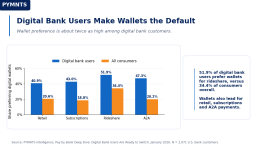
Digital bank customers are already behaving like wallet-first users, and that matters for any PSP trying to move them from card rails to Pay by Bank. In a PYMNTS Intelligence report with Trustly, based on a survey of 2,071 U.S. bank customers, digital bank users came out younger, more mobile-focused, and far more likely than other consumers to prefer digital wallets.
- 44.6% of digital bank customers prefer digital wallets, versus 22.7% of consumers overall. That gap is the whole story here: these users are not just aware of wallets, they already treat them as the default payment interface. For payment providers, that lowers the friction of introducing login-based checkout and tokenized credentials.
- 40.9% of digital bank users prefer wallets for retail purchases. Debit cards still lead with 29.5%, and credit cards follow at 18.9%. The point for merchants is simple: wallet usage is no longer confined to a couple of mobile-first niches.
- Wallets also lead in rideshare, subscriptions, gambling and account-to-account payments. The report says 51.9% use wallets for rideshare payments, 43% prefer them for subscriptions, and 37.7% choose them for groceries. It also says wallets lead for gambling and account-to-account payments, while debit still has the edge for groceries and bills.
- Incentives move the numbers. Digital bank users said they would shift as much as 35.4% of account-to-account transactions to Pay by Bank when discounts and buyer protection are included. They could also move 32% of bill payments, 28.8% of gambling transactions and 27.3% of rideshare purchases. For PSPs and merchants, that is the commercial opening: the product has to be easy, and the economics have to be visible.
- 69% of digital bank customers already view Pay by Bank as a debit substitute, or would do so with rewards, buyer protection or both. Immediate cash benefits were the leading incentive for 43.1% of digital bank users, while 16.9% cited buyer protection. That is a useful reminder that direct bank payments do not need to be positioned as a theoretical future state; they need to look like a better current option.
For banks, merchants and payment providers, the practical takeaway is that wallet familiarity can act as the bridge to Pay by Bank. These customers already understand phone-based checkout and digital credentials; the remaining job is to make protections and value explicit enough that switching feels like a payment choice, not a homework assignment.
Related news
All news →
/https://i.s3.glbimg.com/v1/AUTH_da025474c0c44edd99332dddb09cabe8/internal_photos/bs/2026/5/8/wJ124LQnGWUwa17eqhAQ/header-candidatos.png)
Weekly high-risk digest
Regulation, sanctions and payment news across your verticals — once a week, free.
Please check your inbox and click the link to confirm your subscription.
Please enter a valid email address!