Four agencies, zero impact study: Brazil’s Planning, Revenue Service, and Civil House confirm the Bets MP was drafted without an impact assessment
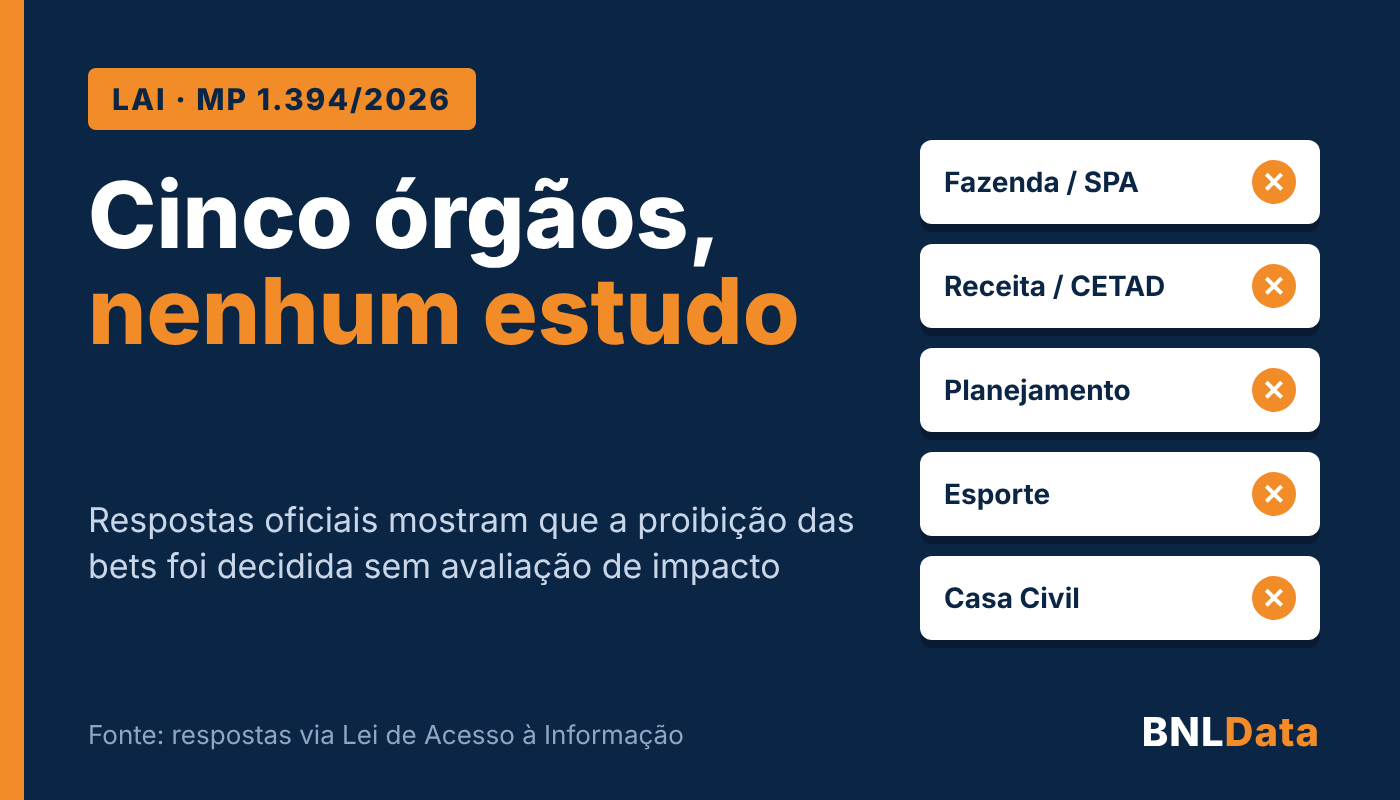
Brazil’s access-to-information replies now show that the ban on fixed-odds betting did not come with a formal impact study from the Ministry of Planning and Budget, the Receita Federal’s CETAD, or the Civil House. For PSPs, that is the useful part of the story: a policy that can reshape payment flows was advanced without the usual paper trail that operators and acquirers normally use to price risk.
- After the Ministry of Finance and the Ministry of Sports, responses filed under Brazil’s LAI (Access to Information Law) show that three more federal bodies had no study, technical note, or impact estimate on the betting ban. The requests were sent on 20 September to the Ministry of Planning and Budget (MPO), the Receita Federal’s Center for Tax and Customs Studies and Research (CETAD), and the Civil House of the Presidency.
- The MPO replied on 13 October, on the last day of the deadline, under NUP 03002.000745/2026-94, with a finding of “Information does not exist.” Its Subsecretariat for the Management of the Evaluation Cycle (SUAV) said that, within the Public Policy Monitoring and Evaluation Council (CMAP), no evaluations were carried out that were “relevant to changes in the referred public policy or to betting in general.” In other words, over more than 21 months, the federal body tasked with evaluating public policies did not examine the betting sector once — neither before nor after the MP.
- The ministry’s answer also says it does not hold data or documents related to an assessment of possible changes to the federal fixed-odds betting policy. For operators, processors, and acquiring teams, that matters because this is the kind of internal assessment that usually underpins restrictions, carve-outs, or transition periods. Here, there was no such internal record on file.
- The Receita’s CETAD answered with Nota SIC Cetad/Coest no. 186, NUP 18800.145988/2026-22, signed on 29 September, four days after the MP was published. CETAD said that Nota Cetad/Coest no. 009/2026 and Nota Cetad/Coest no. 023/2026 were the only documents it had produced on the topic “to date,” and added that it did not know of any other body or entity that had produced or held other documents. So the technical area that tracks federal revenue had not produced any new estimate of what the Union would stop collecting once the ban was already in force.
- The Civil House, which coordinates the drafting of provisional measures, extended the deadline on 29 September and replied only on 23 October under NUP 00137.008286/2026-73. The original text says it limited itself to placing the process under secrecy. The rest of that response, at least in the source cited here, is not available.
The Reuters-style takeaway for high-risk payments is simple: this was not just a political decision; it was a decision taken without a visible analytical trail across three core parts of the federal machine. When a betting rule change reaches that stage, PSPs should assume the legal text may move faster than the economic rationale.
Related news
All news →


Weekly high-risk digest
Regulation, sanctions and payment news across your verticals — once a week, free.
Please check your inbox and click the link to confirm your subscription.
Please enter a valid email address!