Brazil’s betting ban could push R$25 billion into the illegal market
Just weeks after Brazil’s federal government banned fixed-odds betting, the early numbers point in one direction: offshore operators. For PSPs, acquirers, and banks watching the market, the important part is not the headline prohibition but the migration pattern it creates.
- On 25 September 2026, the federal government banned the exploration, offering, intermediation, and advertising of fixed-odds betting across Brazil by decree. The stated goal was consumer protection. According to an article by Gustavo Delbin and Mariana Chamelete published in Poder360, the practical effect is the opposite: demand does not disappear when betting is banned. It moves.
- The report “Brasil: O Custo da Proibição”, published in October by IBIA (International Betting Integrity Association) using estimates from H2 Gambling Capital, says about 60% of the volume that moved through the legal market — roughly R$25 billion — will continue to be wagered, but through unlicensed operators. On that basis, the illegal market is expected to jump from R$17 billion to R$42 billion.
- Blask data suggests the shift was already visible almost immediately. Offshore sites’ share of betting demand was 3.4% on the eve of the MP. Four days later, it had risen to 9.9%, the highest level since regulation began, nearly tripling in less than a week. The report notes that this is likely conservative, because the metric measures searches, while many bettors switch through mirror links and messaging groups outside the radar.
- Of the more than 25 million Brazilians who were betting on regulated platforms up to September, the projection is that about 21.6 million will keep betting, with almost all of that activity outside the state’s reach. That is the operational issue for payment providers: the volume does not vanish, but the route, the visibility, and the control points do.
- The regulated market had actual controls: identity verification via CPF and biometrics, a ban on credit cards, cryptocurrencies, and third-party payments, a national self-exclusion system, blocking of Bolsa Família and BPC beneficiaries and people in debt-renegotiation programs, and customer support channels. In August 2026, more than 5 million Brazilians were blocked from betting because of those safeguards. Without regulation, Brazil loses the data those controls generated in the first place.
The same logic applies to sports integrity. IBIA says alerts involving Brazilian sport rose from an average of 11 per year between 2021 and 2024 to 25 in 2025. That does not mean more manipulation necessarily happened; it means more of it became visible. In the illegal market, there is no self-exclusion, no limits, no protection for children and adolescents, and no reporting of suspicious bets. If someone wants to manipulate a match, the offshore lane is the one with less friction and less paperwork.
Related news
All news →
South Korea urges exchanges to raise cold storage after $6.3 billion Binance hack
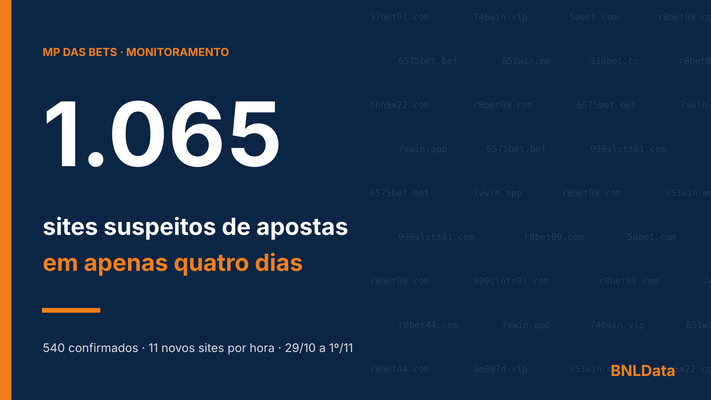
1,065 suspected betting sites appeared in four days as Brazil’s legal market lapse opened space for unlicensed operators

Kim Yo-jong denounces FBI claim linking North Korea to Binance hack as political provocation
Weekly high-risk digest
Regulation, sanctions and payment news across your verticals — once a week, free.
Please check your inbox and click the link to confirm your subscription.
Please enter a valid email address!