Brazil’s government collected more from bets than operators earned, according to the tax math
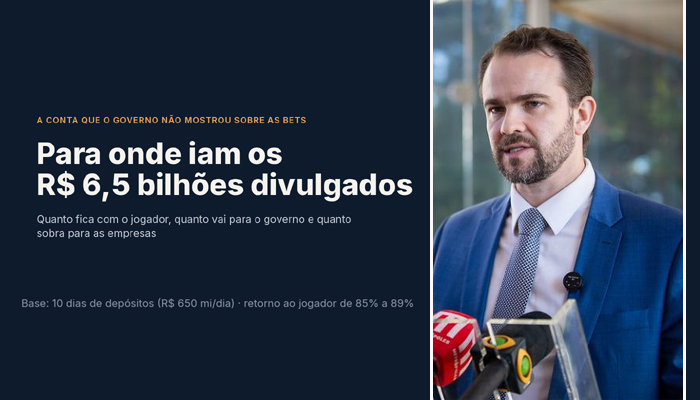
Brazil’s finance ministry framed betting deposits as money “leaving household savings,” but the numbers in the government’s own data tell a different story: most of that money went back to players, while the state took a bigger share than the operators’ net win in some scenarios. For anyone running payments into Brazil’s betting market, the distinction between deposits, payouts, and GGR (gross gaming revenue) is the difference between a headline and the actual unit economics.
- Finance Minister Dario Durigan said on Tuesday (6) that between R$ 600 million and R$ 650 million per day was leaving “popular savings” and going to betting companies, and that in 10 days this would add up to R$ 6.5 billion, equivalent to 8 million basic food baskets. The source of the figure was Banco Central data on transfers to betting accounts, which measures money entering platforms, not money permanently lost by players.
- The official numbers cited by the ministry point to a different picture. According to data from the Fazenda ministry, obtained by BNLData via the Access to Information Law, GGR reached R$ 36.9 billion in 2025 and R$ 20.07 billion in the first half of 2026. That works out to about R$ 101 million per day in 2025 and R$ 111 million per day this year, roughly one-sixth of the amount the minister presented.
- The same review shows how much of the money stayed on the books. There were 86.2 million accounts with balances between R$ 0.01 and R$ 0.99, and 1% of bettors, about 200,000 people, accounted for 80% of the R$ 1.325 billion still pending return. In other words, the balance sheet looks like mass-market recreational play with small residual balances, not household savings trapped on betting platforms.
- On a R$ 6.5 billion deposit base, a player return rate of 85% to 89% means R$ 5.53 billion to R$ 5.79 billion goes back to bettors in winnings. That leaves GGR of R$ 715 million to R$ 975 million, or 11% to 15% of the total. From there, the government takes its cut through a 13% contribution, ISS (2% to 5%, depending on the municipality), PIS (1.65%) and Cofins (7.6%).
- At an 85% return rate, those taxes total R$ 236.4 million to R$ 265.7 million. At 89%, they fall to R$ 173.4 million to R$ 194.8 million. After that come operating costs, averaging 40% of GGR, which leaves the operators with far less than the headline deposit numbers suggest. In the source’s own summary, the government could take up to 1.8 times the operators’ profit.
The practical takeaway for PSPs and acquirers is simple: in Brazil, deposits are not revenue, and deposit volume is not the same thing as operator margin. If you are underwriting betting flows, the useful metrics are GGR, payout rates, tax load, and settlement behavior — not the size of the gross inflow headline.
Related news
All news →


Weekly high-risk digest
Regulation, sanctions and payment news across your verticals — once a week, free.
Please check your inbox and click the link to confirm your subscription.
Please enter a valid email address!