IBIA Says Brazil’s Betting Ban Could Expand the Illegal Market to R$42 Billion and Weaken Match-Fixing Controls
The International Betting Integrity Association (IBIA) says Brazil’s ban on fixed-odds betting and online gaming could undo much of the regulatory setup built over the last 21 months. The practical issue for PSPs and operators is simple: when betting moves out of the licensed system, consumer checks, payment controls, and suspicious-activity monitoring get thinner fast.
- On 25 September 2026, Brazil imposed a nationwide ban on fixed-odds betting, including sports betting and online gaming, just 21 months after opening its regulated market. Congress is still considering whether the ban should become permanent, so the current setup is not yet the final word.
- IBIA says Brazil had already made meaningful progress in a short time: more than 80 operators were authorised, customer identification requirements were introduced, illegal betting websites and associated payment channels were targeted, and a centralised self-exclusion system was established. Those are the sort of controls that matter when a market is trying to keep payments and betting flows inside the perimeter.
- For sports integrity, licensed operators were required to monitor suspicious betting activity, report potential concerns, and cooperate with national and international sports integrity monitoring organisations. IBIA’s point is that this creates intelligence: suspicious patterns can be identified, assessed, and shared with regulators, sports bodies, and law enforcement. If activity shifts outside the licensed market, that information flow shrinks.
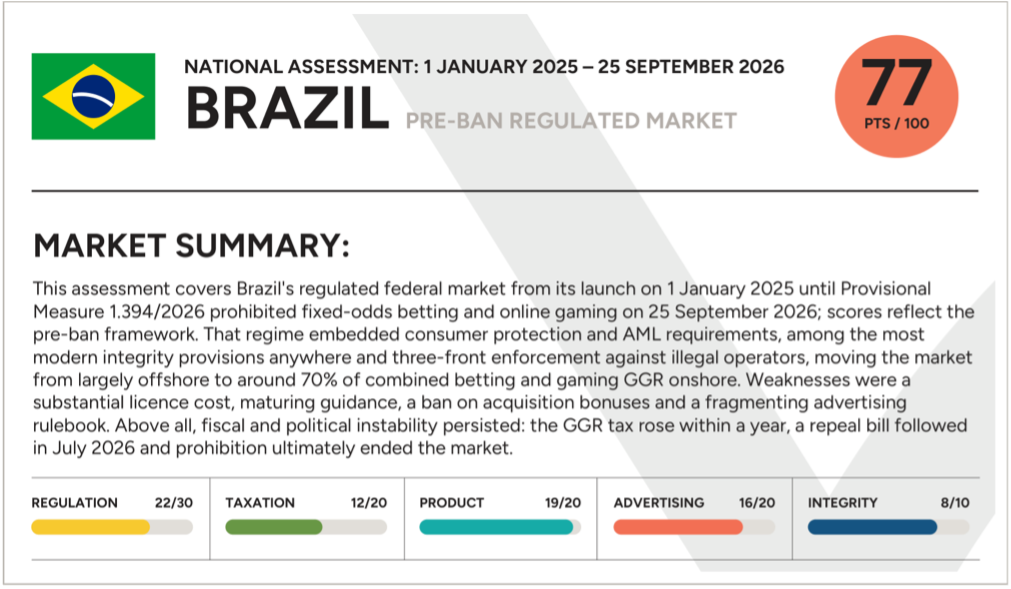
- IBIA’s comparative assessment of regulatory frameworks gave Brazil a score of 77 out of 100, above Portugal’s 68 and below Great Britain’s 86. That matters because Brazil had already climbed into the group of markets with structured reporting obligations rather than a free-for-all.
- H2 Gambling Capital estimates that around 60% of the activity currently served by Brazil’s regulated market, equivalent to approximately R$25 billion, could migrate to unlicensed operators if the legal alternative disappears. On that basis, the illegal market could grow from around R$17 billion to approximately R$42 billion. For payment providers, that is not just a betting statistic; it is a signal that more volume may move into channels with less KYC, weaker consumer safeguards, and fewer reporting obligations.
IBIA also reported 25 suspicious betting alerts involving Brazilian sports in 2025, the first full year of the regulated market, compared with an annual average of 11 alerts between 2021 and 2024. The association says that increase should not be read as proof that corruption is rising; it may simply reflect more visibility once betting is brought into a monitored, reportable environment.
Related news
All news →:strip_exif()/i.s3.glbimg.com/v1/AUTH_59edd422c0c84a879bd37670ae4f538a/internal_photos/bs/2026/o/D/vLtFB3T1qgmgtx2HPt7w/37447615496-4cb71e3490-k.jpg)

Weekly high-risk digest
Regulation, sanctions and payment news across your verticals — once a week, free.
Please check your inbox and click the link to confirm your subscription.
Please enter a valid email address!