Home
/
news
/
ANSEJA uses AGU’s own data to argue in Brazil’s Supreme Court that the Bets MP made the illegal market grow
news
ANSEJA uses AGU’s own data to argue in Brazil’s Supreme Court that the Bets MP made the illegal market grow
In ADI 8024, the Association for Legal Security in Games and Betting says Brazil’s government issued MP 1.394 without an impact study and is now trying to shut down a regulated market without showing that the move actually reduces illegal supply. For high-risk PSPs, the key point is less the constitutional argument than the data trail: the state’s own filings appear to show illicit promotion expanding after the measure took effect.
- ANSEJA filed a 35-page petition on 20 November to Minister Luiz Fux, the rapporteur in the cases challenging Provisional Measure No. 1.394/2026. The association says it is not disputing the social risks of gambling and betting — it explicitly cites addiction, debt and the exposure of vulnerable people — but argues that a total ban is not a proportionate response when regulatory alternatives exist, clandestine supply continues, and the state itself keeps operating lotteries.
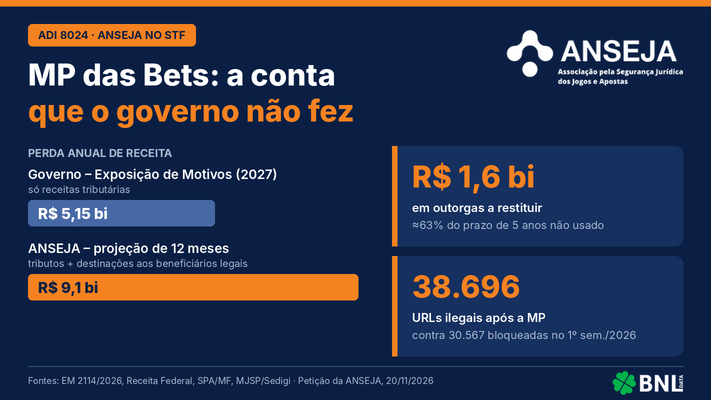
- The association’s main evidentiary point comes from Information No. 39/2026 from Sedigi, the Digital Rights Secretariat of Brazil’s Ministry of Justice, which the AGU added to the case on 17 November. Between 25 September and 9 November, in the first weeks after the MP took effect, the study recorded 60,677 instances of promotion of irregular betting: about 51,611 websites, 6,596 Facebook pages, 1,442 Telegram groups, 886 Instagram profiles, 127 TikTok profiles, 14 WhatsApp groups, and one Discord server. The combined audience was approximately 204.2 million users, and on 9 November alone 3,531 new items appeared.
- ANSEJA accepts the government’s own caveat that the combined audience is not the same as unique users and that the study has no pre-MP baseline. It then cross-checks that data against Informative Note No. 3005/2026 from the Secretariat of Prizes and Betting (SPA), also attached by the AGU. From January to June 2026, when the market was regulated, 30,567 URLs of unauthorised operators were blocked. After the MP, in just a few weeks, 38,696 URLs offering illicit betting were identified and flagged for blocking. The association’s point is straightforward: if the government wants to justify prohibition, it needs to show that prohibition reduces illegal supply, not just assume the demand will disappear politely.
- The petition also challenges Article 4 of the MP, which extinguished the authorisations after 30 days and prohibited any refund of the amount paid. Each authorisation cost R$ 30 million, was valid for five years, and raised about R$ 2.55 billion for the federal government in total. Counting validity from January 2025, around 38 of the 60 months would go unused, or 63% of the term. On ANSEJA’s calculation, that would mean a refund of approximately R$ 1.6 billion, excluding compensation for investments that have not yet been amortised.
- The filing also notes that Caixa Loterias S.A., a subsidiary of Caixa Econômica Federal, is part of the picture, which matters because Brazil’s betting debate is not just about private operators versus the regulator. It also runs into the awkward fact that the state remains an operator in the same broader gambling ecosystem it is trying to shrink.
Related news
All news →
news
Court rulings involving online betting platforms in Brazil jump 122% before MP 1.394 ban

news
Brazil counts more than 60,000 records tied to illegal betting promotion as fake sites clone licensed brands
news
Loterj prepares criminal complaint against RioPag over origin of R$ 16.5 million payment
Weekly high-risk digest
Regulation, sanctions and payment news across your verticals — once a week, free.
Please check your inbox and click the link to confirm your subscription.
Please enter a valid email address!