The ABRAS study used to celebrate the end of betting does not add up
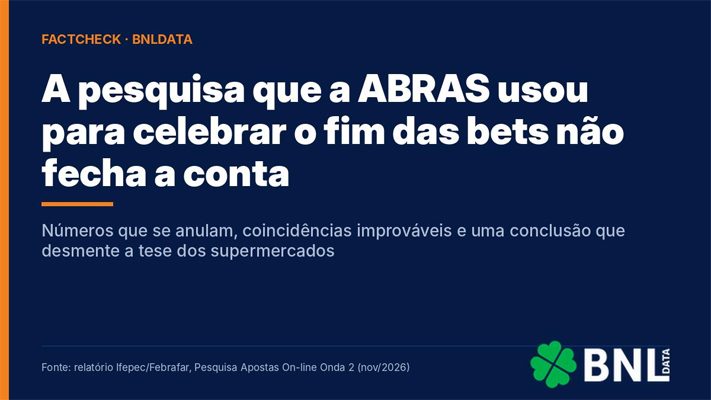
The Brazilian supermarket association ABRAS pointed to an Ifepec/Febrafar survey to argue that the ban on fixed-odds betting helped October household consumption. The problem is that the report’s own tables contradict each other, and its conclusions end up saying the opposite of what ABRAS wants them to say.
- At a Thursday press conference on the 26th, ABRAS said October household consumption rose 5.75% and that this “categorially confirms” the importance of banning bets. To support that claim, João Carlos Galassi cited a national survey of bettors by the Instituto Febrafar de Pesquisa e Educação Corporativa (Ifepec).
- BNLData obtained the full 19-page Wave 2 report, dated November 2026 and signed by Prof. Rodnei Domingues, with credits to NEIT/Unicamp and the Instituto Axxus. A table-by-table reading shows a document that does not survive its own arithmetic, and in the conclusions it says the opposite of what ABRAS wants readers to take from it.
- The report says it re-interviewed 1,489 bettors between October 20 and November 20. In question C.1, 701 of them, or 47.1%, say they bet in the last 30 days. In question D.1, asked to the 1,030 who bet after the MP, 788, or 76.5%, say they bet “nothing” in the last 30 days. Same time window, same respondents on paper, and yet 459 bettors disappear from one table to another.
- The contradictions do not stop there. In D.3, 1,025 of the same 1,030 respondents, or 99.5%, say they suffered losses in the last 30 days, but 788 of them did not bet at all in that period. The report also says 96.0% had no winnings, while the note below the table says 90%. In C.3, 8 respondents, or 0.8%, say they bet on a “legal platform” after the ban, even though the report itself notes that there was no authorized fixed-odds platform live since October 6.
- The report’s favorite “robust finding” is a match between bettors and family members. It says exactly 459 bettors stopped betting; in the family sample, which has 1,500 people and is independent by design, exactly 459 also say the relative stopped. The report presents 30.8% and 30.6% as evidence of convergence, but those are the same absolute number divided by different bases. Even if the real proportions were identical, the chance of two independent samples of that size hitting the same absolute count is about 1 in 60.
One more detail matters for anyone using surveys to defend policy or payment decisions: the number 788 appears three times in three different categories. In C.1, 788 did not bet in the last 30 days. In C.2, 788 bet “much less” than before. In D.1, 788 bet “nothing” after the ban. For PSPs, acquirers, and merchants in high-risk verticals, that is a reminder that policy claims built on shaky data can collapse fast when someone checks the tables.
Related news
All news →
Binance co-CEO links $6.3 billion hack to AI permissions as laundering continues through THORChain and CoinJoin

Changpeng Zhao Says Binance Leadership Complacency Helped Enable a USD 6.3 Billion Attack

Czech authorities charge 15 in BETFIN blockchain casino case after 2.3 million bets were reviewed
Weekly high-risk digest
Regulation, sanctions and payment news across your verticals — once a week, free.
Please check your inbox and click the link to confirm your subscription.
Please enter a valid email address!