Trybit on Latin America’s $593.8B digital assets surge: what stablecoin payments now need to do
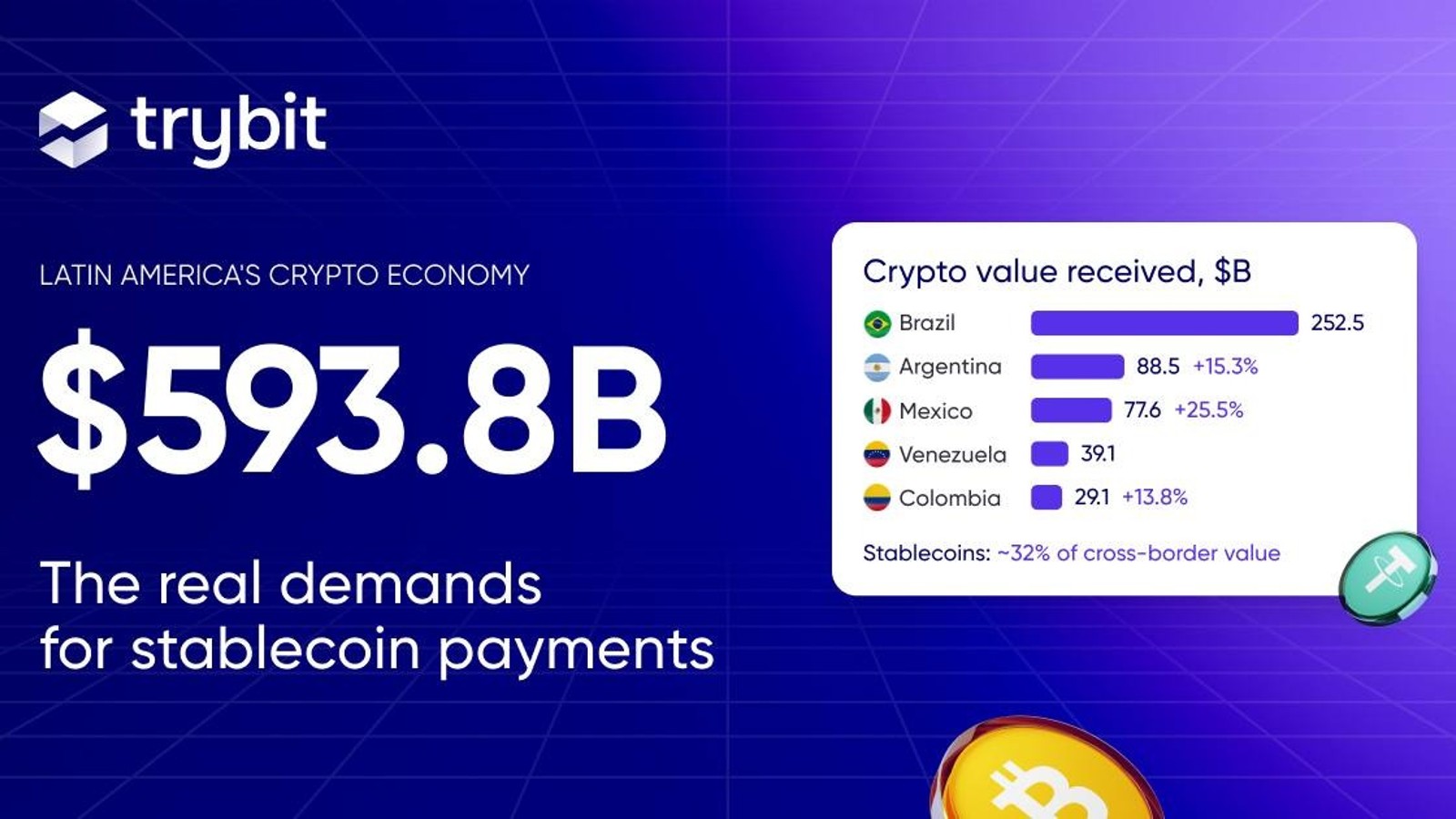
Latin America’s crypto economy reached $593.8 billion in the 12 months to June 2026, and a growing share of that volume is moving through stablecoins for business settlement rather than speculation. For PSPs and payment gateways serving online businesses, the practical question is no longer whether stablecoins are accepted, but whether the infrastructure can handle volume, pay out on time, and screen risk before funds land.
- Latin America’s crypto activity hit $593.8 billion, up 9.8% year over year. According to Chainalysis, the region grew even as global crypto flows fell. Latin America is now the world’s sixth-largest crypto economy, which matters because that scale changes stablecoins from a niche rail into something payment teams actually have to operationalize.
- Brazil, Mexico, Argentina, and Colombia are doing the heavy lifting. Brazil accounted for $252.5 billion, or 43.7% of the regional total. Mexico reached $77.6 billion, up 25.5%, which was the fastest growth among the region’s three largest markets. Argentina reached $88.5 billion (+15.3%), while Colombia reached $29.1 billion (+13.8%). In Brazil, wallets holding at least $10,000 in stablecoins rose 347% since July 2024.
- Stablecoins are now a material part of cross-border flow. By June 2026, stablecoins represented about 32% of the region’s cross-border crypto value. Mexico stands out here: monthly stablecoin value on corridors with either endpoint in Mexico reached $1.8 billion in June 2026, roughly four times its early-2024 level. Mexico also ranks fifth in the world for cross-border flows.
- Business usage is rising, and not just in theory. In June 2026, Bitso, which operates in Mexico, Colombia, Brazil and Argentina, said stablecoin usage by its business customers rose 81% year over year. Juanita Rodríguez Kattah, Bitso’s Colombia country manager, told Chainalysis: “The technology is now trusted enough to carry real corporate volume.” That is the point where payment infrastructure stops being an experiment and becomes part of the settlement stack.
- Trybit says three things decide where online businesses route volume. First, stable acceptance under load: downtime at peak traffic means lost sales, so uptime matters more as volume grows. Second, on-time payouts: revenue in stablecoins only works if withdrawals and partner payouts leave on schedule. Third, clean incoming funds: payments linked to risky addresses can lead to frozen accounts at exchanges, so screening every incoming transaction before crediting it reduces that risk.
For online businesses selling internationally, holding revenue in USDT or USDC removes exposure to local currency swings and opens payment routes that banks often restrict. In practice, that shifts the buying decision for gateways and PSPs from “can you support stablecoins?” to “can you keep them moving, settle them on schedule, and keep the flow clean enough that the account does not get stuck later?”
Related news
All news →
NBA signs prediction-market deal with Kalshi and Polymarket amid integrity concerns and state scrutiny

SkillOnNet secures a Finnish gambling licence ahead of the 1 July 2027 market opening
Pinco lists QR SBP as its payment method with MTS as merchant and MTS Bank as the receiving bank
Weekly high-risk digest
Regulation, sanctions and payment news across your verticals — once a week, free.
Please check your inbox and click the link to confirm your subscription.
Please enter a valid email address!