Brazil’s betting ban failed to win votes and may have backfired in the election
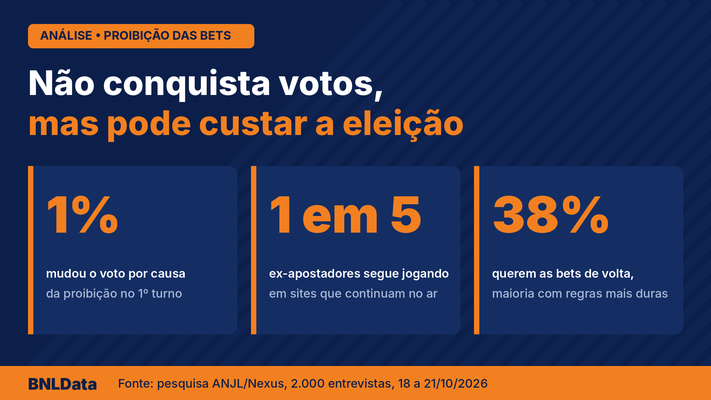
An ANJL/Nexus survey says the government’s anti-betting push converted almost no voters, pushed one in five bettors toward the illegal market, and left 38% of Brazilians unrepresented in a tied second round. For regulated PSPs and operators, the useful part is obvious: a ban that does not suppress demand tends to move volume, not remove it.
- The government treated the betting ban as an election weapon. It issued Provisional Measure No. 1.394/2026 ten days before the first round, pushed the issue in campaign messaging, and even called it a “bets plebiscite.” But the Nexus poll, commissioned by the Associação Nacional de Jogos e Loterias (ANJL), says the move did not win voters, did not pull bettors out of the market, and created a bloc of dissatisfied voters that no campaign chose to represent.
- In a second round where Flávio Bolsonaro and Lula are tied at 50% of valid votes in a 22 October Datafolha poll, that margin matters. Among first-round voters who knew about the ban, only 6% changed their candidate because of it, or about 1% of the electorate. In the second round, 77% say the issue will have no influence at all, and among the rest, 80% say it only reinforces a choice they had already made.
- The survey’s uncomfortable point for policymakers is that the ban spoke mostly to people who were already convinced. The group that says the measure influenced them is also the group most supportive of it, at 74%, with a more optimistic view of the economy and a preference for issues in the government’s agenda. In other words: the government spent political capital, disrupted a regulated sector, and put public revenue at risk to consolidate votes it already had.
- On the campaign trail, Lula did not even mention bets in his TV Globo interview or in the Band debate. That is usually a sign that a slogan is better at polling than at winning votes. The article also says that 38% of Brazilians are left without representation in a second round tied at 50%.
- The more important operational result is not electoral. Before the MP, 18% of respondents were betting on sites or apps. After it, 4% of the sample still bet on sites that remain online. That works out to about one in five former bettors, and more than half of them, 52%, are using the same site as before.
The survey argues that the real-world effect is to remove the regulated protections that came with licensed play: deposit limits, self-exclusion, identity verification, a credit ban, and a complaint channel. The state also stops collecting tax and stops supervising the activity. For PSPs, the pattern is familiar: prohibition does not eliminate demand; it pushes that demand toward operators that do not pay tax, do not answer to a regulator, and do not offer responsible-gaming controls.
Related news
All news →

Weekly high-risk digest
Regulation, sanctions and payment news across your verticals — once a week, free.
Please check your inbox and click the link to confirm your subscription.
Please enter a valid email address!