Brazil’s Fabio Macorin joins the IAGR Board as the country’s betting market enters full operation in 2025
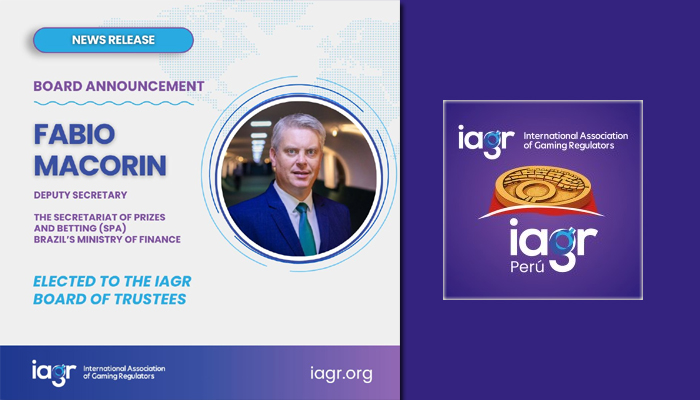
Fabio Macorin, deputy secretary at Brazil’s Secretariat of Prizes and Bets (SPA-MF), has been elected to the Board of Directors of the International Association of Gaming Regulators (IAGR). For payment teams and compliance heads, the useful part is not the title itself but the mix of regulatory, AML, and enforcement experience he brings from the center of Brazil’s newly regulated fixed-odds betting market.
- Macorin’s appointment gives the IAGR Board a South American perspective at a time when regulators are dealing with similar cross-border issues, according to IAGR President Ben Haden. He said Brazil completed an “ambitious regulatory transformation” in a very short period, and that Macorin’s experience will be useful to the association’s global community.
- At SPA-MF, Macorin plays a leading role in implementing, supervising, and enforcing Brazil’s federal fixed-odds betting framework. Since joining the Ministry of Finance in 2024, he has been directly involved in monitoring licensed operators, fighting the illegal market, strengthening controls against money laundering and terrorist financing, and coordinating enforcement with other government bodies and private-sector players.
- Before moving to the Ministry of Finance, Macorin spent 17 years in the Brazilian Federal Police, including 10 years focused specifically on investigating and preventing banking and financial fraud. That background is the reason his regulatory profile is weighted toward AML, financial monitoring, illegal-market suppression, and interagency cooperation rather than pure policy theory.
- Brazil’s regulated fixed-odds betting market formally entered operation in 2025 and has since become one of the gaming industry’s most closely watched regulatory experiments globally. Macorin also served as Undersecretary of Monitoring and Enforcement and has worked on initiatives to combat illegal operators, deepen cooperation with financial institutions and telecom providers, and develop data-based tools for regulatory supervision and enforcement.
For PSPs, acquirers, and banks looking at Brazil, the signal is clear: the market is being shaped by a regulator with strong law-enforcement DNA, a heavy AML focus, and active coordination with financial institutions and telecoms. That usually means tighter monitoring, more information sharing, and less room for sloppy operator onboarding.
Related news
All news →


Weekly high-risk digest
Regulation, sanctions and payment news across your verticals — once a week, free.
Please check your inbox and click the link to confirm your subscription.
Please enter a valid email address!