Illegal betting market multiplies after Brazil’s betting ban, monitoring shows
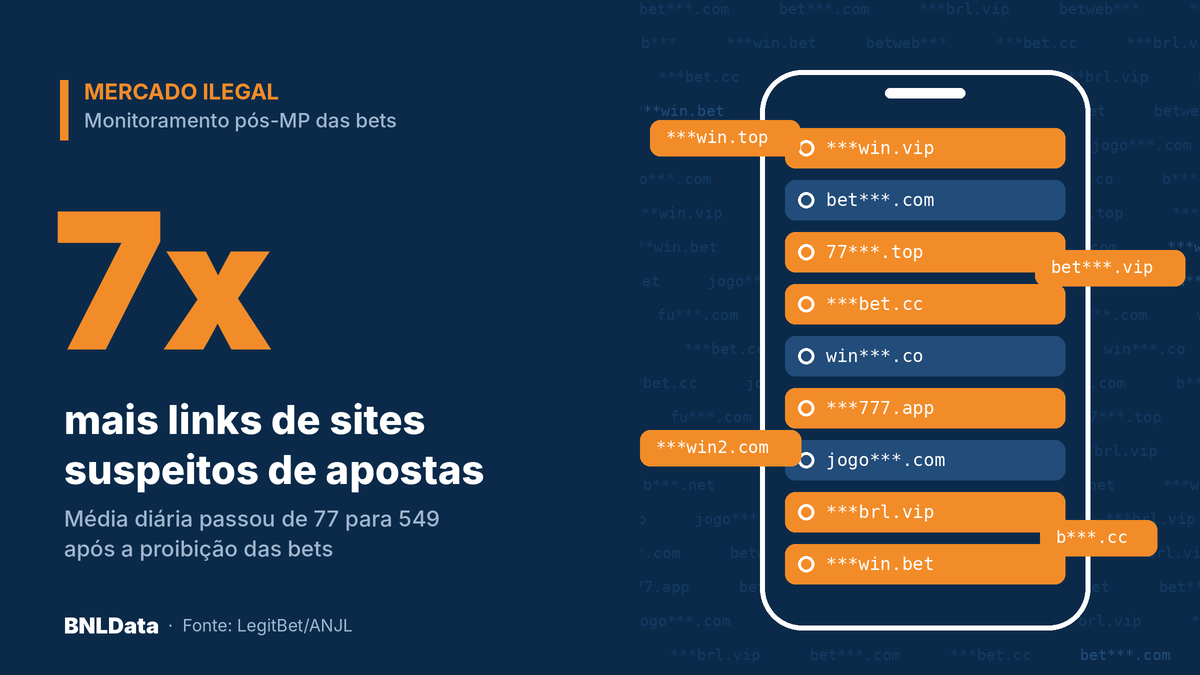
The ban on authorized betting sites in Brazil did not stop online betting activity; it appears to have shifted it into a larger, noisier gray market. A report from LegitBet, shared by the Associação Nacional de Jogos e Loterias (ANJL), shows suspicious link distribution jumping roughly sevenfold after the MP took effect, with new suspect domains also appearing in volume.
- By October 8, the LegitBet system had detected 41,716 suspicious sites and confirmed 30,593 of them. On that day alone, two days after authorized platforms had taken their sites and apps offline, 79 new suspicious sites appeared, 55 of them confirmed as suspicious. Between October 2 and 7, the system registered between 70 and 233 new domains per day.
- The sharper move was in distribution, not just domain creation. Between September 8 and 23, monitored channels averaged 77 suspicious links per day. After the MP banning bets entered into force on September 25, that average rose to 549 links per day between October 1 and 7, about seven times higher. The peak came on October 7, with 948 links, one day after legal sites were removed; on October 8, there were 733.
- The 55 sites confirmed on October 8 fit the usual illegal-market profile: disposable domains, generic endings, and aggressive offers. According to the report, 82% had numbers in the domain name, with entire families of addresses differing only by digits; one name appeared across 13 domains. The most common extension was .com at 43.6%, followed by .vip at 12.7% and .bet at 7.3%, with .org, .cc, .co, .net and .top also appearing. The pages offered “Fortune games,” PIX payments, registration with just a mobile number, daily bonuses, referral bonuses, and in one case a bonus of up to R$ 1 million.
- As for where the detections came from, internet search accounted for 32%, other databases for 30%, networks of already monitored sites for 18%, Telegram channels for 13%, and social networks for 8%, including Kwai, Instagram, Reddit and Snapchat. In Telegram, 90% of detected sites were confirmed as suspicious.
- The report is careful about what it claims. It does not label any address illegal; it only flags domains that match the patterns tracked by the monitoring system. Individual cases still depend on analysis by the authorities. Since October 5, it has counted only sites aimed at the Brazilian public. Domains on Anatel’s blocklist are excluded from the totals, as are pages of authorized operators. In other words, the numbers are conservative by design, which means the clandestine market is probably bigger than the report’s count suggests.
For PSPs and acquirers, the useful takeaway is not the politics of the ban, but the operational pattern: when regulated access shuts down, traffic migrates fast, domain churn rises, and promotional distribution gets louder. That is exactly the sort of environment where merchant onboarding, URL monitoring, and beneficiary screening stop being nice-to-haves and become the only thing standing between “we didn’t know” and a messy compliance file.
Related news
All news →
:strip_exif()/i.s3.glbimg.com/v1/AUTH_59edd422c0c84a879bd37670ae4f538a/internal_photos/bs/2026/o/D/vLtFB3T1qgmgtx2HPt7w/37447615496-4cb71e3490-k.jpg)

Weekly high-risk digest
Regulation, sanctions and payment news across your verticals — once a week, free.
Please check your inbox and click the link to confirm your subscription.
Please enter a valid email address!