Fux puts legal certainty at the center of Brazil’s Supreme Court hearing on the betting ban
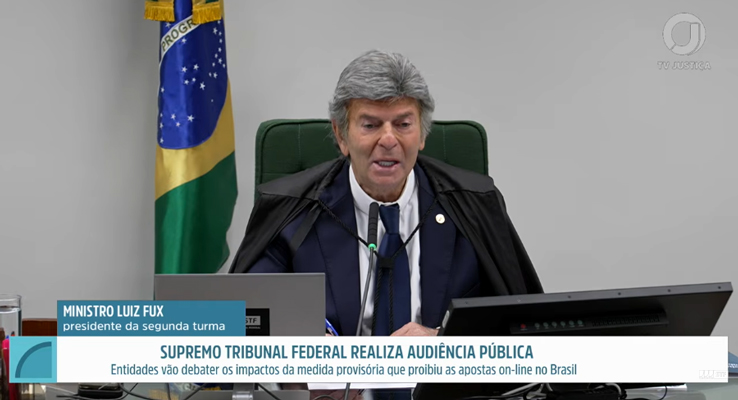
At the STF’s 52nd public hearing on Medida Provisória 1.394/2026, Minister Luiz Fux framed the fight over fixed-odds betting less as a morality play and more as a question of legal certainty, retroactivity, and whether the government can shut a licensed market overnight. For regulated gambling businesses and their payment partners, that is the part that matters: if the court leans toward modular relief, the timeline for exits, refunds, and contract unwindings changes materially.
- Fux opened the hearing on Tuesday (3) and spoke for about 35 minutes. He said his personal view is that bets “should be banned” and described gambling addiction as “a public health problem,” but stressed that his position is “one vote,” not eleven. In other words, he separated his personal stance from the legal questions now before the court.
- The core of his remarks was legal certainty. He said the MP raises “arguments of legal certainty,” “non-retroactivity of the law to perfect legal acts,” and “protection of legitimate expectation.” He also pointed to doubts over whether the measure met the constitutional requirements of relevance and urgency for a provisional measure. For PSPs, acquirers, and banks, that is the framework that decides whether an abrupt shutdown survives judicial scrutiny or has to be softened.
- Fux called legal certainty a “petrea clause” and an “invaluable value,” saying that without it country risk rises and can cut 0.2 to 0.5 points off economic growth, in his estimate. He added that every government act must protect legitimate expectation: “We believe in the Public Power.” That line is not just rhetoric; it signals that the court may look hard at whether operators and counterparties were entitled to rely on the regime in force when they entered the market.
- He also reminded the room that the Supreme Court has a habit of modulating decisions. In his telling, when the court finds a law unconstitutional, it checks whether abolition can happen “ex abrupto” or whether a transition period is needed. He cited the São Paulo Public Defender’s Office case, where the court declared unconstitutionality but gave the state time to adjust. That is the important precedent-style logic for the betting market: the court has a tool for avoiding sudden shocks, and Fux made a point of putting that tool on the table.
- The timing of MP 1.394 makes the point sharper. It was published on September 25 and gave authorized companies ten days to wind down operations. It also eliminated paid licenses with five-year terms that had been granted by the government less than two years earlier. For companies with payment flows, sponsor contracts, and settlement obligations still running through the system, this is exactly the sort of change that turns legal theory into operational risk.
Fux also pushed back on criticism on social media that he had invited only companies and football clubs. For market participants, the more relevant fact is that the hearing is now explicitly anchored in the language of legitimate expectation, perfect legal acts, and modulation. That is usually where the real decision sits.
Related news
All news →
Paraguay’s central bank launches resolution process for Ueno bank after solvency shortfall

FactCheck BNLData: the report Janja handed to Fux does not support the ban the government is defending

Brazilian fintech Bloquo raises US$3.67M seed round to build stablecoin payment infrastructure
Weekly high-risk digest
Regulation, sanctions and payment news across your verticals — once a week, free.
Please check your inbox and click the link to confirm your subscription.
Please enter a valid email address!