Home/news/German gambling safeguards face a cash-wallet test over SCHUFA G and Tipwin deposits
news
German gambling safeguards face a cash-wallet test over SCHUFA G and Tipwin deposits
Payments High Risk
3 Sep 2026 · 2 min read
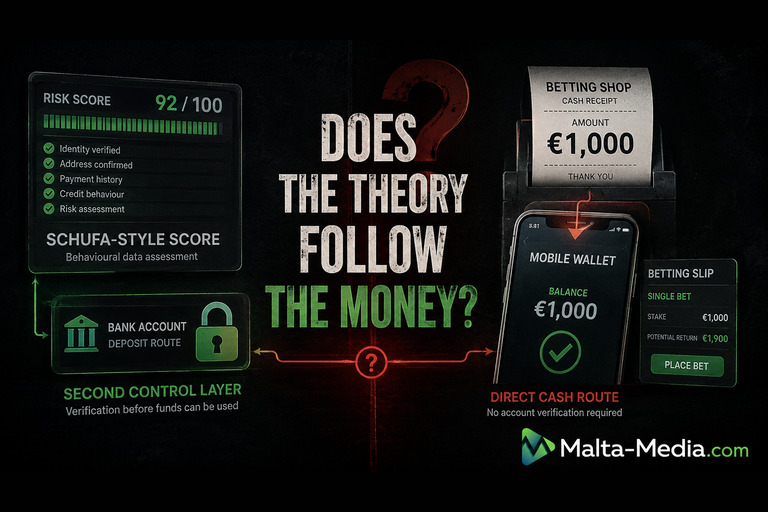
Professor Bernd Grzeszick’s defence of SCHUFA G assumes that regulated gambling in Germany is funded through an authorised bank account before the player can spend. The problem is that some of the evidence around Tipwin’s Shop Geldbörse Plus wallet points to cash entering the system first, which matters for PSPs, acquirers and operators trying to understand where the real control points sit.
In a November 2025 presentation reviewed by Malta Media, Grzeszick described the funding of regulated gambling as a kind of “prepaid model”. On his account, a player usually has to deposit money from an authorised bank account before any gambling loss can occur, while the bank already knows the customer and may have assessed overdraft or other credit facilities. In other words, the deposit is supposed to act as another control layer before the risk becomes real.
That theory runs into the Shop Geldbörse Plus files examined in the previous article in the series. One June test dossier shows a customer with a provider-wide LUGAS limit of €50, a €1,000 cash deposit at a Tipwin shop, and then a mobile Tipwin wager afterwards. Other files describe smaller cash deposits entering the same wallet before betting through the app away from the counter. The material is not an official regulatory finding, but the customer journey it describes does not start with a transfer from the player’s bank account.
That does not prove SCHUFA G is unlawful, and it does not prove Tipwin’s product breaches German gambling law. It does test the factual assumption behind the extra safeguard: if cash can be turned into remotely spendable betting credit, then the bank is not always the second lock. For payment providers, that is the practical question, because a control framework built around bank-account visibility does not cover every route into the wallet.
Grzeszick’s formal assignment was narrower: state liability for continued use of SCHUFA G when higher limits are approved. His conclusion that officials currently face no damages liability does not answer whether every payment route is controlled in the way the theory assumes. The article’s point is simple enough: the market shown by the evidence may not be the market assumed by the model.
Prof. Dr Bernd Grzeszick, LL.M. is not a casual commentator here. He directs Heidelberg University’s Institute for Constitutional Law, Constitutional Theory and Legal Philosophy and has been a member of the Constitutional Court of North Rhine-Westphalia since 2021. Heidelberg University’s publication record lists a 28-page 2025 opinion commissioned by the German Sports Betting Association and the German Online Casino Association on state liability arising from the use of SCHUFA G for higher limits under §6c of the Glücksspielstaatsvertrag.


/https://i.s3.glbimg.com/v1/AUTH_da025474c0c44edd99332dddb09cabe8/internal_photos/bs/2026/L/X/Y2kp8xTamTitx8onnVeA/esportecapa.jpg)