Brazil’s bet ban has not yet delivered the Black Friday boost retailers wanted
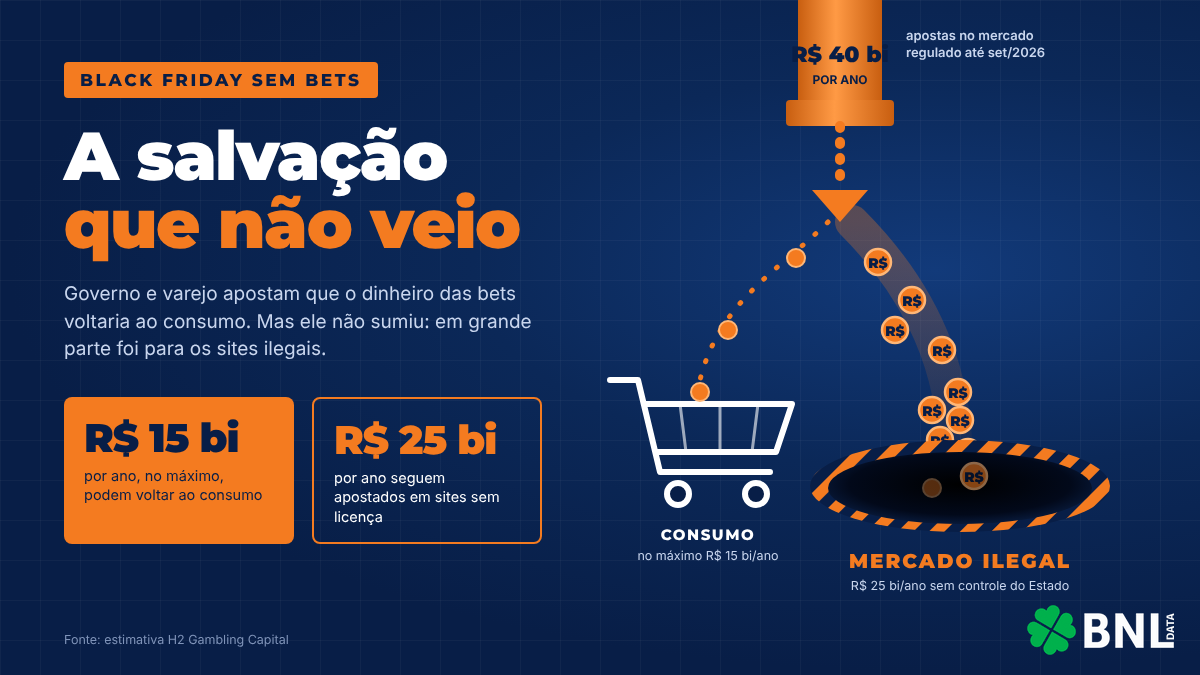
Two months after Provisional Measure No. 1.394 of September 25, 2026, Brazil’s Finance Ministry and parts of the retail sector are still treating the end of bets as a consumer-spending tailwind. The problem is simple: there are no numbers showing that this is happening, and the betting money has not disappeared — it has shifted into the illegal market.
- The Ministry of Finance folded the argument into its Macrofiscal Bulletin published on November 23, saying the ban on bets could create “additional dynamization” at year-end. Débora Freire, the ministry’s secretary for economic policy, said the ban is among the factors helping Brazil avoid a recession in 2027 and described bets as a sector “with few linkages and that generates income loss.”
- That same revision, however, cut the 2026 GDP forecast from 2.0% to 1.9% and the 2027 forecast from 2.3% to 1.8%, while raising expected 2026 inflation from 4.9% to 5.3%, above the top of the target range. The market is still more cautious: the Boletim Focus points to growth of 1.7% this year and 1% next year.
- The private sector is on the same script. ABRAS blamed the ban for an “atypical” 6.5% increase in supermarket sales in the week of October 5 to 11, without controlling for the long holiday or withdrawals of balances from betting platforms. Marcos Molina, chairman of MBRF, said it “may be one of the best Christmases for retail, due to not having bets,” citing “sources in retail.” Carrefour says that without bets, “there is more money left in family budgets” and that “we are already feeling this effect,” but gave no numbers.
- On the Black Friday side, the data does not show a clear windfall. A Valor survey of eight sources found forecasts ranging from a nominal decline of 2.5% to growth of 24%, with the strongest numbers driven by e-commerce, which has been growing faster than physical retail for years, with or without bets. In other words: if the sales bump arrives, it is not showing up as a clean, bet-ban-shaped macro effect.
- Specific sector forecasts are still modest. CNC expects real growth of 1.8% in Black Friday sales, to R$ 11.5 billion, just over half of the 3.2% growth seen in 2025, and says the slowdown reflects interest rates, debt and international purchases rather than bets. IEMI expects a nominal decline of 2.5%, while Marcelo Prado, partner-director at the consultancy, said the end of bets may bring only a small boost to food retail, which is not the driver of Black Friday. Abrasce expects nominal growth of 3% at shopping malls, which would mean a real decline with inflation above 4.6%.
For high-risk payment players, the useful detail is not whether retail would like the story to be true. It is that the money did not vanish when the legal betting rails were curtailed; according to the text, it moved into the illegal market. That is the kind of migration PSPs, acquirers and banks tend to care about more than the headline debate over whether Black Friday gets a little more money in the basket.
Related news
All news →
Brazil’s Federal Police tie illegal betting platforms to a R$ 4.3 billion money laundering scheme

Loterj sues RioPag over BRL9.3 million owed to licensed betting companies in Rio de Janeiro

SOFTSWISS panel flags Brazil’s betting ban and Mexico’s 50% tax as a Latin America warning shot
Weekly high-risk digest
Regulation, sanctions and payment news across your verticals — once a week, free.
Please check your inbox and click the link to confirm your subscription.
Please enter a valid email address!