Jogo do Bicho Turns 136: Born Legal to Save a Zoo, Then Became Brazil’s Case Study in Why Bans Don’t Kill a Game
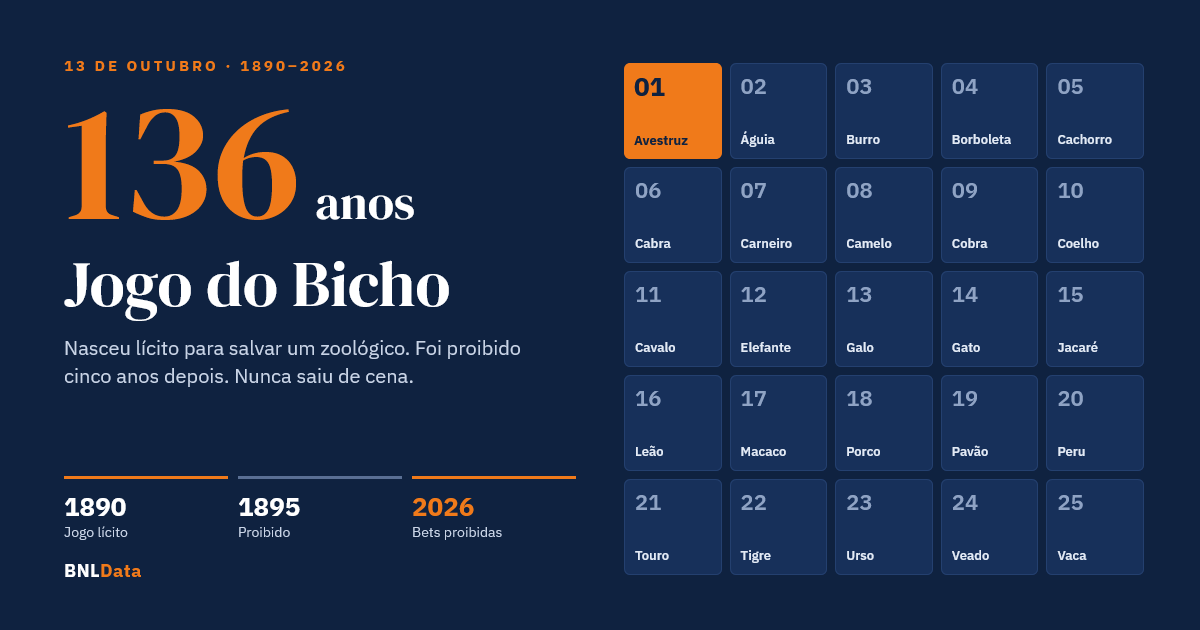
Created in 1890 as a “lawful public game,” Jogo do Bicho was banned in 1895 and still survived more than a century underground. For high-risk payments people, that is the whole thesis in one sentence: if demand is there and the channel is profitable, prohibition often just changes the distribution model.
- On 13 October 1890, João Batista Viana Drummond, the Barão de Drummond and founder of the Rio de Janeiro Zoo in Vila Isabel, got permission through an addendum to the zoo’s founding contract to operate “jogos públicos lícitos” in order to raise money after the Imperial subsidy disappeared with the 1889 Proclamation of the Republic.
- The idea did not come from Drummond. According to the account, the Mexican visitor Manuel Ismael Zevada proposed adapting the Loteria das Flores into a “loteria dos bichos” that could generate revenue for the zoo. Zevada was then named the first manager of the operation.
- The mechanics were simple: a 1,000 réis ticket came with an animal image, and at the end of the day a board was raised showing the animal of the day. If it matched the ticket, the visitor won 20,000 réis. Drummond had 25 animals painted, which is the same number of groups the game still uses today.
- The first official draw took place on Sunday, 3 July 1892, and the winning animal was the ostrich, which still sits in group 1 of the table.
- The game was prohibited in 1895, but it outlived the Empire, the Old Republic, the Estado Novo, the military dictatorship and the New Republic. In the article’s framing, it has survived 131 years of prohibition and, in practice, became a street-level betting network after merchants and intermediaries began selling tickets beyond the zoo walls.
The point for PSPs, acquirers and banks is not the nostalgia. It is the structure: once a wagering product develops a broad user base, a recognizable payout system and intermediaries willing to distribute it, a ban does not erase demand — it pushes the activity into informal rails.
Related news
All news →
Weekly high-risk digest
Regulation, sanctions and payment news across your verticals — once a week, free.
Please check your inbox and click the link to confirm your subscription.
Please enter a valid email address!