Brazil’s regulated betting sector tells Supreme Court MP 1,394 gets the premise wrong: banning bets does not make the market disappear

At a public hearing before Supreme Federal Court Justice Luiz Fux, industry groups and lawyers argued that Provisional Measure 1,394/2026 would hand the betting market to organized crime, undermine legal certainty, and fail the urgency test. For PSPs and operators, the real issue is straightforward: if regulation is replaced by prohibition, the payment flow does not vanish — it moves.
- ANJL said the government is treating prohibition as if it were the same thing as market elimination. Pietro Lorenzoni of the Associação Nacional de Jogos e Loterias (ANJL) described this as an “error of premise” and said the authorities were arguing from the assumption that banning bets means no more betting. He pushed back on the data used to justify MP 1,394, pointing to Lenad 3, which cites 11 million people with potential gambling disorder, but dates from 2023 and covers all forms of gambling, not just regulated bets that did not yet exist.
- The sector’s chronology was used to argue that the market existed long before regulation. Lorenzoni said bets have operated in Brazil since 2005, reached R$ 2 billion in 2013, more than R$ 5 billion in 2018, and R$ 28 billion in 2023, before Law 14.790. His line was simple: regulation did not create the market; it was an attempt to tame an existing one. He echoed the “dragon” metaphor used by Attorney General Jorge Messias: “the dragon was already there.”
- ANJL also listed what licensed operators have already paid into the system. According to Lorenzoni, operators have delivered R$ 30 million outorgas each, almost R$ 3 billion to public coffers on top of taxes, more than R$ 1 billion per year to football, R$ 2.6 billion to Olympic and Paralympic sport, and R$ 1.4 billion in advertising. He also cited Ministry of Finance data showing a 32% drop in betting volume in 2026 and more than 60% channeling into the regulated market, which he said meant regulation was working.
- The dispute is not only about access, but about liability and compensation. Lorenzoni argued that the MP is wrong to assume operators would not be entitled to compensation: “A provisional measure cannot protect the federal government from damages that it itself causes.” Fux also blocked a video Lorenzoni wanted to show on how easy it is to access a betting site, saying that with the MP in force the demonstration could amount to an illegality.
- Abracrim warned that the draft creates dangerous legal gaps for bettors themselves. Milton Jordão, speaking for the Associação Brasileira de Advogados Criminalistas (Abracrim), said the MP leaves “dangerous voids,” including the risk that the very bettor it claims to protect could end up facing money laundering exposure. The hearing also included ANJL, Abracrim, Abracopel, ANSEJA and IBJR, all of which argued that the measure violates legal certainty and does not meet the urgency requirement.
For high-risk payment providers, the practical takeaway is not subtle: Brazil’s betting rails are still a policy battleground, and any shift from regulated access to prohibition tends to reprice risk rather than erase it.
Related news
All news →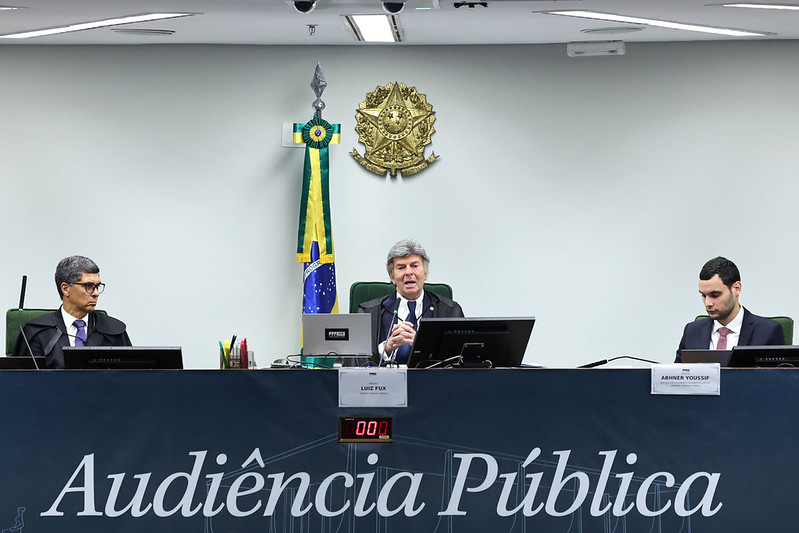
No STF, PGR avoids taking a position on Brazil’s bets MP as Fux says the Court may “decide not to decide”

Brazil’s Sports Ministry Told the STF That Match-Fixing Controls Only Exist Because Betting Is Regulated

Brazil’s betting ban does not mean no gambling, ANJL tells Supreme Court hearing
Weekly high-risk digest
Regulation, sanctions and payment news across your verticals — once a week, free.
Please check your inbox and click the link to confirm your subscription.
Please enter a valid email address!