Home
/
news
/
Bets Ban Has Broad Support in Brazil, but the Voting Effect Looks Small — and That Still Matters in a Tight Race
news
Bets Ban Has Broad Support in Brazil, but the Voting Effect Looks Small — and That Still Matters in a Tight Race
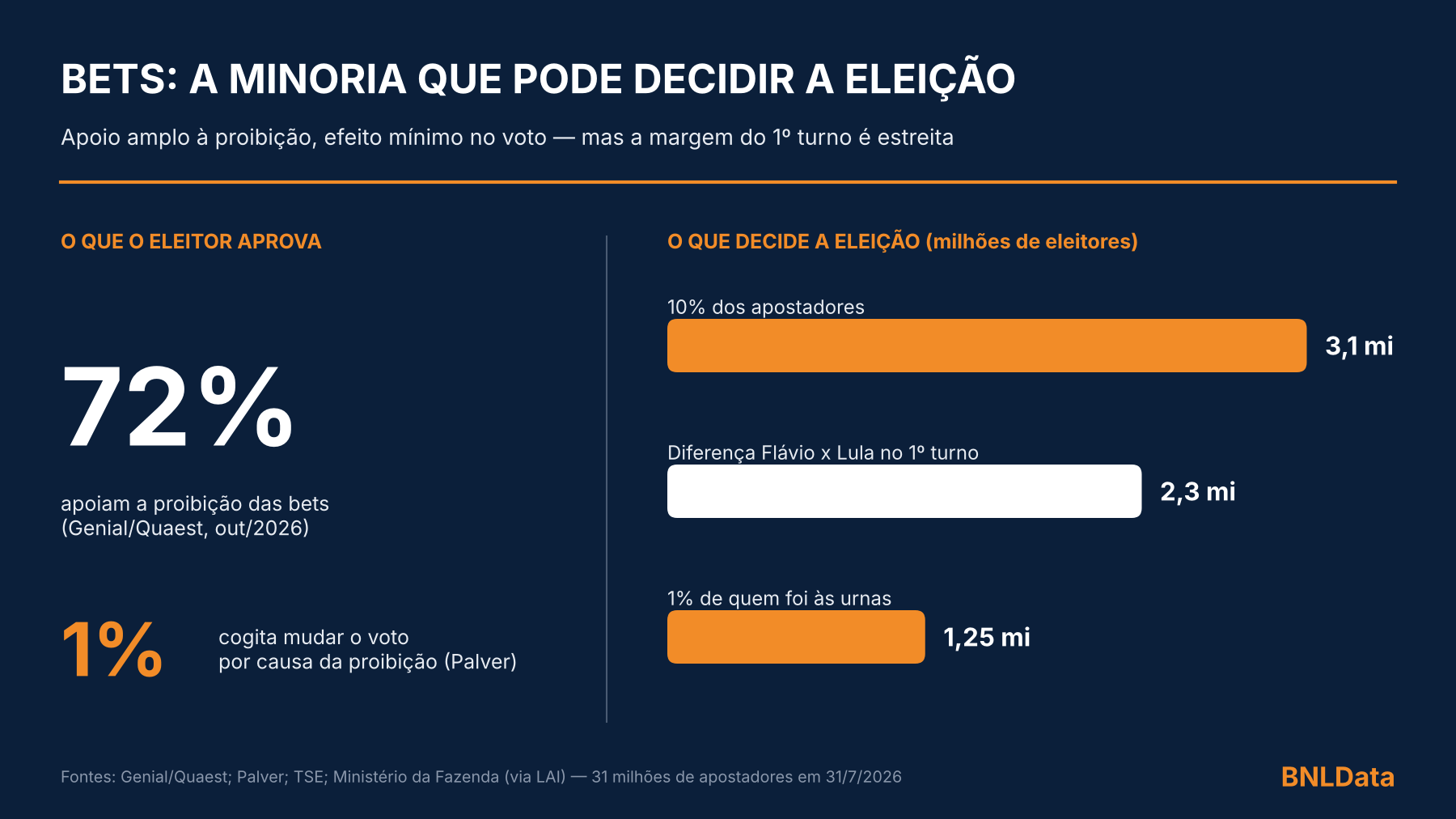
Polling in Brazil shows strong support for banning bets, but very little willingness to change a vote because of the issue. That matters for PSPs and merchants: a policy can be popular without becoming electorally useful, and in a close contest even a small shift can matter.
- The Genial/Quaest poll released on Wednesday, 14 found that 72% of Brazilians support a ban on bets. Of those, 64% already knew about the proposal and approved it, while another 8% moved into the pro-ban camp after being informed. Opposition totaled 21%: 17% already knew the proposal and disapproved, and 4% reacted negatively once they learned about it. Another 7% did not know or did not answer.
- Earlier polling had already pointed to the same pattern: broad support for the ban, but almost no electoral effect. In Cruz Consulting/ANJL polling among beneficiaries of social programs, 68.1% said candidates’ positions on bets would not change their vote, and only 1% would switch to a candidate who supported ending betting. More in Common/Ipsos-Ipec found that 58% of the electorate would not change their vote because of bets. Indexa/Broadcast showed 70% in favor of the ban, but 63% said the topic would not influence their vote, while only 14% said it would influence them a lot. Palver found that only 1% of voters were considering changing their vote after the ban.
- The practical problem for Lula is that the election was not being decided by giant swings. With 100% of the ballots counted in the first round, Flávio Bolsonaro had 47.03% of valid votes, or 56.1 million, and Lula had 45.16%, or 53.8 million. The gap was about 2.3 million votes out of 119.3 million valid votes. At that scale, 1% of voters who actually show up is roughly 1.25 million people, which is more than half the distance between the two candidates.
- BNLData had already run the math before the MP. On 16 September, nine days before the announcement, it published “Por que proibir as bets pode custar a eleição a Lula.” Using data obtained from the Ministry of Finance through Brazil’s Access to Information law, the outlet said Brazil had more than 31 million bettors on 31 July 2026. Its point was simple: if 10% of those recreational bettors, about 3 million voters, were bothered enough by the measure, reelection could be put at risk.
- The silence makes sense once you separate approval from voting behavior. Support for the ban is diffuse: people may like the idea, but still vote based on the economy, security, or dislike of the other candidate. Opposition, by contrast, is more intense. For payment providers and operators, that is the useful takeaway: a policy can be broadly acceptable in principle and still be a weak mobilizer at the ballot box.
Related news
All news →
news
Dutch regulator to work with Meta and Google on a whitelist of iGaming operators
news
Weekly iGaming licensing roundup: New Zealand advances 11 bidders, Wildz gets Finland’s first online licence, and Louisiana delays DraftKings renewal

news
Visa and Mastercard face £700 million UK claim over post-Brexit EEA card fees
Weekly high-risk digest
Regulation, sanctions and payment news across your verticals — once a week, free.
Please check your inbox and click the link to confirm your subscription.
Please enter a valid email address!