Brazil hits 1.2 million self-exclusions in eight months, ahead of older betting regimes
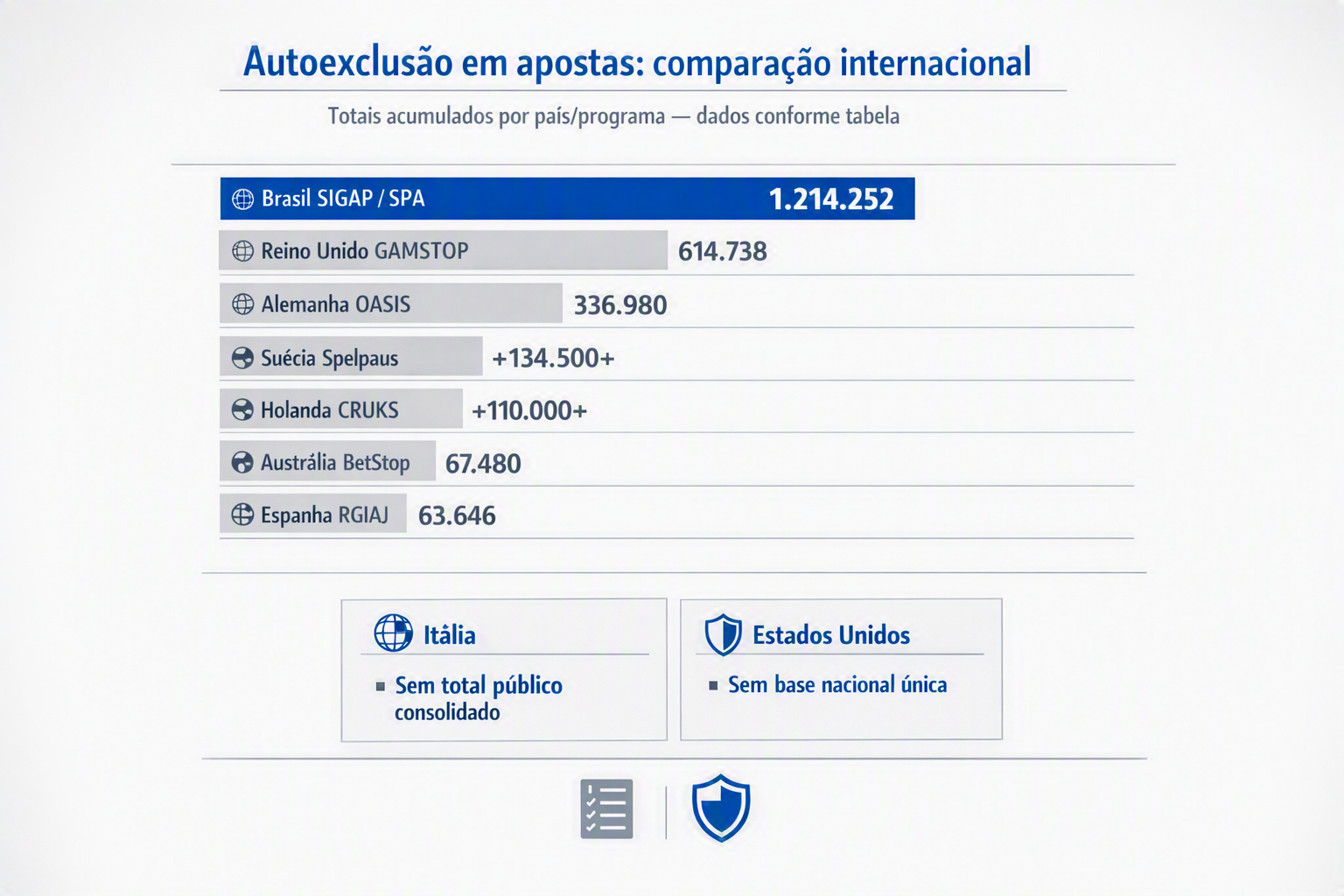
Brazil’s centralized self-exclusion platform reached more than 1.2 million requests by September 2026, according to the Ministry of Finance’s Secretaria de Prêmios e Apostas (SPA). For PSPs and operators, the useful part is not the headline number itself, but the speed: a newly regulated fixed-odds market got to a volume that tops the big national self-exclusion schemes in the UK, Germany, and Sweden.
- The 1.2 million figure comes from the Plataforma Centralizada de Autoexclusão, launched by the SPA in December 2025. The total represents 3% of the 40 million active CPFs registered in the Sistema de Gestão de Apostas (Sigap).
- BNLData, using official data from regulators in seven countries, says Brazil’s total now exceeds nearly all major national self-exclusion programs currently in operation. In absolute terms, Brazil is ahead of long-running systems that have had years to build their numbers.
- The speed is the real story. Brazil’s platform has been live for about eight months, while GAMSTOP in the United Kingdom took eight years to reach 614,738 cumulative registrations. Sweden’s Spelpaus needed seven years to pass 134,000, and Germany’s OASIS took four years to go beyond 336,000.
- The source is careful about the comparison, and so should anyone reading it for risk management. The Brazilian 3% is calculated against active bettors in Sigap, while countries such as the UK, Sweden, and the Netherlands often use total adult population as the base. Germany’s OASIS also allows the same person to self-exclude more than once over time, which can inflate the total number of registrations.
- Another caveat: the scope is not identical across systems. Some registers, such as Spain’s RGIAJ, cover only state-level online gambling, while others, including Brazil’s and Australia’s, cover broader segments. So this is not a clean league table of “who has the most problem gamblers”; it is a comparison of how quickly each market’s self-exclusion plumbing starts getting used.
For high-risk operators, the practical takeaway is simple: Brazil’s compliance stack is being used at scale very early in the market’s life. That tends to mean more pressure on onboarding controls, account monitoring, and self-exclusion checks, because regulators now have hard numbers showing the system is not just there for decoration.
Related news
All news →


Weekly high-risk digest
Regulation, sanctions and payment news across your verticals — once a week, free.
Please check your inbox and click the link to confirm your subscription.
Please enter a valid email address!