Visa and Mesh let consumers spend crypto and stablecoin balances at 175 million merchant locations
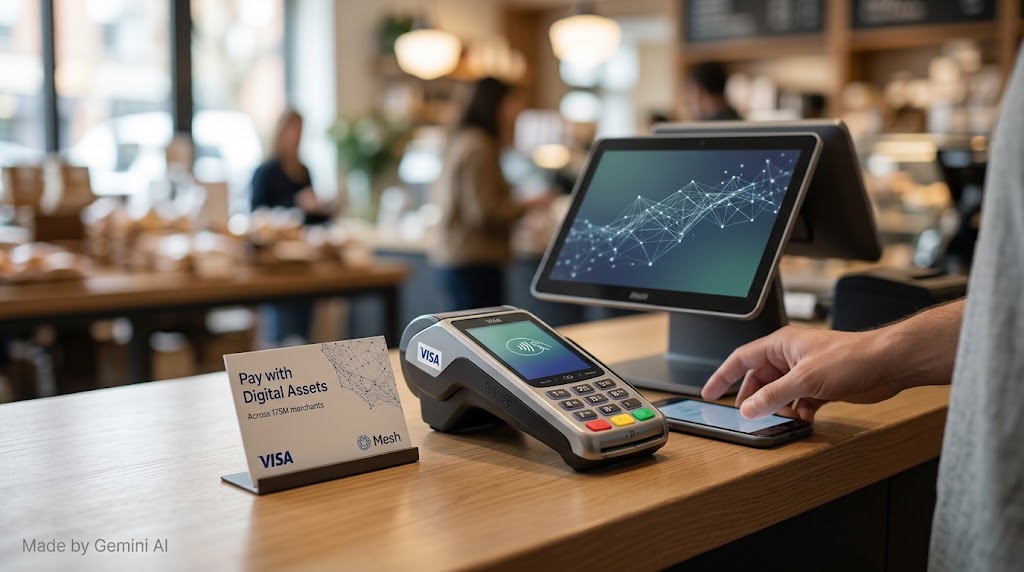
Visa and Mesh have announced a partnership that lets consumers pay directly from crypto or stablecoin wallets across Visa’s acceptance network of 175 million merchant locations in more than 200 countries. For PSPs and high-risk merchants, the point is not the crypto angle itself; it is the attempt to remove one of the remaining steps between digital-asset balances and ordinary card acceptance.
- The model is meant to solve what Mesh calls the “last-mile problem” in digital-asset payments: a consumer can hold crypto or stablecoins, but still has to jump through extra steps before spending them. Under this setup, Mesh provisions a Visa credential behind the scenes, the user checks out as normal, and the merchant receives a standard card payment with no new hardware or workflow changes.
- Mesh says it handles the funding, conversion and, where required, KYC and user onboarding, acting as programme manager. The consumer does not need to pre-sell holdings, move funds to a bank account, or sign up for a separate card tied to a single platform. In practice, that is the piece that tends to break most “spend your crypto anywhere” stories.
- The release cites Crypto.com research putting global crypto ownership at 774 million people as of June 2026. It also references American Banker data showing monthly crypto card volumes at roughly $1.5 billion by late 2025, versus Visa’s $14.2 trillion in fiscal 2025 payment volume. That gap is the whole argument: ownership is one thing, actual spend-through at scale is another.
- Mesh says it already serves more than 200 enterprise clients, including Kalshi, Tools for Humanity, Félix Pago, Majority and KAST, and its network connects hundreds of wallets, exchanges and platforms. That distribution is the commercial logic of the deal: Visa brings merchant acceptance, while Mesh brings the orchestration layer that can aggregate fragmented digital-asset balances into something a merchant can actually take.
- Bam Azizi, chief executive and co-founder of Mesh, said: “Crypto never had a spending problem, it has a last-mile problem, and until now, closing it meant getting a separate card.” He added that Mesh handles the funding and conversion so “a balance becomes purchasing power at the moment of payment, with nothing for the user to move and nothing for the merchant to change.”
The partnership sits inside a broader push by card networks to bring digital assets into existing payment rails. Visa has previously worked with Circle and other stablecoin issuers on settlement rails, and Mastercard has pursued similar orchestration partnerships. Mesh is positioning this as wallet-agnostic, meaning the consumer is not locked into a single issuer or platform, which is the part that matters if you are trying to turn scattered wallet balances into spendable payment volume.
Related news
All news →


Weekly high-risk digest
Regulation, sanctions and payment news across your verticals — once a week, free.
Please check your inbox and click the link to confirm your subscription.
Please enter a valid email address!